
Redknee Tarantula Profile
Tarantulas have historically been the icons of arachnophobes. They’re the spiders found on the backs of the tomb raiders in Indiana Jones, and the monstrous mother morphs of the deadly little huntsmans in Spielberg’s Arachnophobia.
Yet, while there are many deadly spiders to choose from, tarantulas are never among them. And many, like the Mexican redknee tarantulas, are so docile they make a fantastic introductory species to all spider kind.
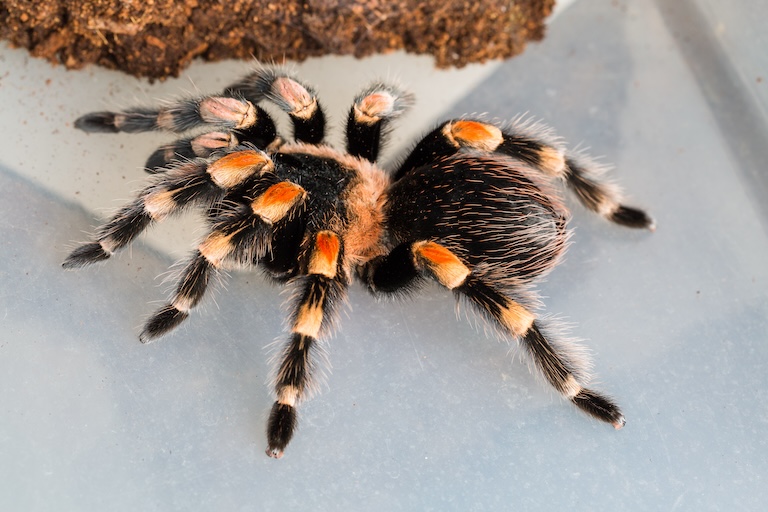
Redknee Tarantula Facts Overview
| Habitat: | Dry scrub, thorn forest, semi-desert |
| Location: | Mexico |
| Lifespan: | 25 to 30 years |
| Size: | Up to 17 cm (6.7 in) leg span |
| Weight: | Up to 16 g (0.6 oz) |
| Colour: | Black with red-orange knee bands |
| Diet: | Insects, small vertebrates |
| Predators: | Birds, reptiles, mammals |
| Top Speed: | Unknown |
| No. of Species: | 2 |
| Conservation Status: | Both are Near Threatened |
Mexican Redknee is the common name for either of two Mexican species of Tarantula. These are large, pretty and slow-moving spiders that are generally not very aggressive and pose no serious threat from envenomation either. But, they do have big pointy fangs that you’d do well to steer clear of, and they are delicate, so it’s best to handle them with care, if at all.
Interesting Redknee Tarantula Facts
1. They’re not “True” spiders
Redknees sit in the genus Brachypelma, and this is one genus within the family Theraphosidae, which houses all of the so-called tarantulas. This family belongs to a wider group of very primitive species that split early from the lineage that would then produce the most familiar species.
So, unlike the spiders you find commonly in the garden or house, tarantulas are from a separate, ancient group of spiders that have different characteristics. Most obviously, their large fangs pierce downwards, as opposed to the sideways style of an orb weaver, or huntsman. Tarantulas are also often much larger in mass and size than their true spider contemporaries.
They also live a lot longer, as a rule. Female tarantulas regularly have lifespans measured in decades, rather than years.
This is where the redknees’ most obvious “non-typical” spider traits come from: downward-facing fangs, heavy bodies, long lifespans, and a reliance on strength and ambush rather than silk engineering. Their lineage is closer to trapdoor spiders than to anything people usually picture as a spider.
2. There are two options
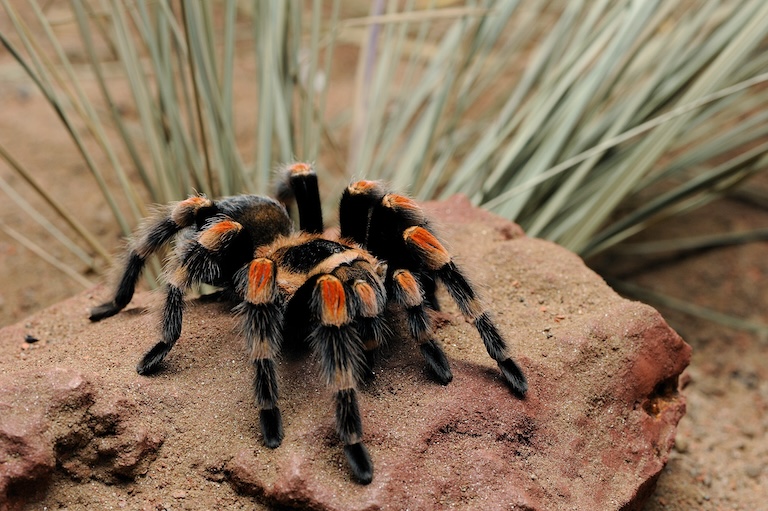
Being a common name, the redknee tarantula isn’t strictly taxonomic and commonly refers to one of two species, which have traditionally been conflated.
Fortunately, they’re very similar, so most of what applies to one, also applies to the other. The most stark difference is in their distribution. While there is some overlap, Brachypelma hamorii is found further north and west in Mexico. It tends to occupy drier thorn scrub and semi-arid habitats close to the coast, often in relatively open ground where burrowing conditions are stable.
Brachypelma smithi, by contrast, has a more southerly and inland distribution. Its range overlaps climatically but is generally associated with slightly more seasonal dry forest and scrub, rather than the more coastal zones typical of B. hamorii.
Most modern sources now differentiate between the two species, dedicating the “redknee” moniker to B. hamorii. But older sources could be referring to either1.
3. They Burrow
Both species burrow into soft ground, which keeps them safe from predators as well as providing a home base from which to ambush prey. These burrows are more than just a simple tunnel, and contain chambers and channels for specific purposes.
Burrows can be found near vegetation, and have a single entrance that splits into up to two chambers. The chambers are safe spaces for the spider to moult inside, and another chamber provides a safe resting space.
When laying eggs or moulting, the spider seals up the entrance with silk.
4. They live for a very long time
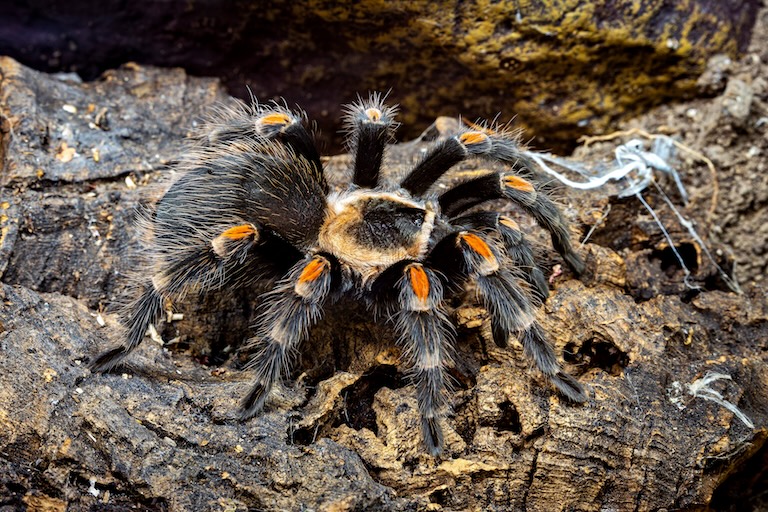
Most true spiders live for a couple of years, sometimes a little more. And that’s just the females; males tend to be tiny, less robust, and often food for the females, and are lucky, therefore, to last more than a year.
Some exceptions might hit 15 years or so, but generally, true spiders don’t live nearly as long as tarantulas. And the Redknees are not about to buck this trend. Males, being the shorter-lived sex, live for five to ten years after reaching maturity.
Females can more than double this, often living for 30 years or more. So, this is a very long-lived animal, which, if taken into account, can still make an excellent household companion.
5. They make good pets!
As far as exotics go, these spiders tick a lot of boxes. First, they’re very good-looking spiders. Secondly, they aren’t very dangerous, and a bite is said to be no worse than a bee sting, but a third reason they’re so popular is that they just aren’t likely to bite unless you really upset them.
They’re relatively easy to handle, less likely to dart around and fall off your hand, and their care is quite low maintenance, with a preference of around 24-28 degrees Celsius and a humidity of around 60%.
The two things to be careful of when keeping one, are the urticating hairs on its back – these are a trait of most New World tarantulas – which can be scratched off and embed into your skin and respiratory pathways to irritate; and the damage that such a weighty spider can incur if it’s dropped from any height.
So, handle with care, and always keep them low to the ground. Finally, and most importantly, if you’re looking to buy one, make sure it comes from a responsible source.
6. Yet they’re still smuggled out of Mexico
Human laziness is the main reason for regulations. As a species, when faced with a quicker route, we will generally abandon our principles entirely to follow it, and so, despite the ease of breeding this species, we are still faced with a lot of pressure on wild populations by the illegal pet trade.
It’s simply faster and cheaper to go and pick one from its habitat than set up a whole breeding operation. As such, both species are in decline and considered Near Threatened by the IUCN2.
There are other threats as well, primarily from increasing urbanisation that removes their natural habitats. To make matters worse, what’s bad for one species becomes bad for the other when illegal and unregulated trade is involved, as the two are often misrepresented as the other.
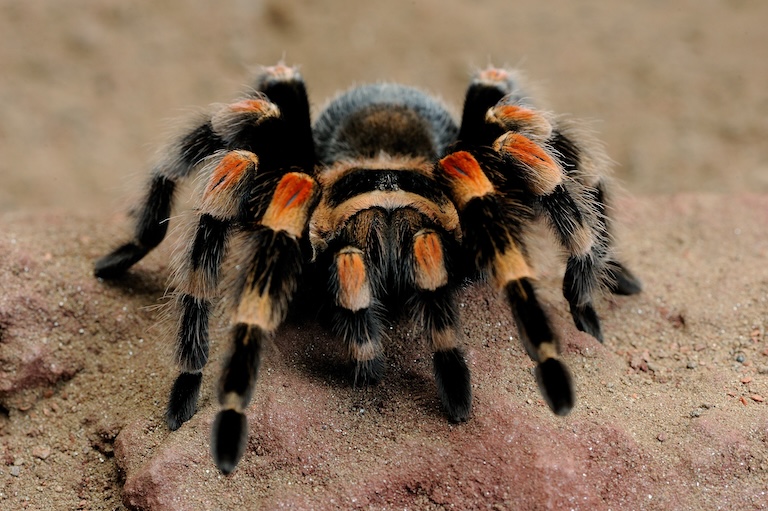
Redknee Tarantula Fact-File Summary
Scientific Classification
| Kingdom | Animalia |
| Phylum | Arthropoda |
| Class | Arachnida |
| Order | Aranaea |
| Family | Theraphosidae |
| Genus | Brachypelma |
| Species | B. smithi or B. hamorii |
Fact Sources & References
- “Mexican Redknee Tarantula”, WildLife Nomads.
- Fukushima et al (2019), “Brachypelma smithi”, The IUCN Red List of Threatened Species.