
Red-tailed Hawk Profile
North America has so much to be proud of. Unfortunately, North Americans appear incapable of picking the focus of their pride sensibly. One true American treasure comes in the form of a large, predatory bird.
This agile, yet powerful monster is the true voice of American freedom, and so, as you’d expect, it’s rarely recognised and falsely attributed. The red-tailed hawk is a rare success story among modern apex predators, and a beautiful example of a precision killing instrument.
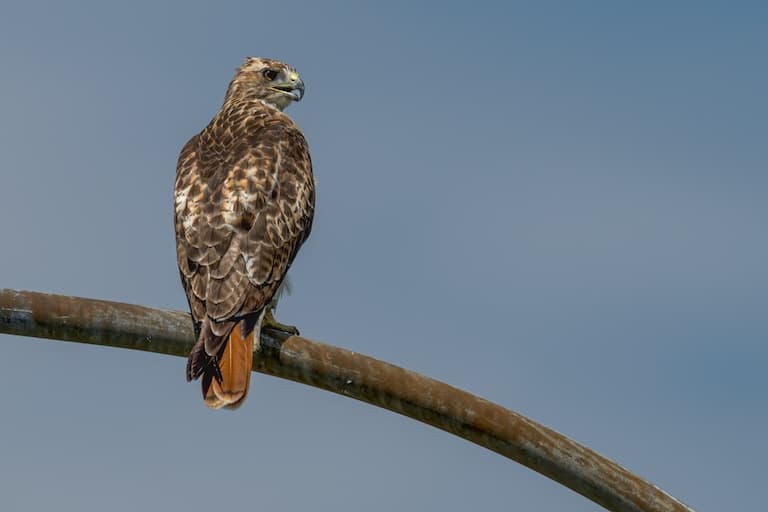
Red-tailed Hawk Facts Overview
| Habitat: | Open country, woodland edges, grasslands, deserts, urban |
| Location: | North America to Panama & West Indies |
| Lifespan: | Up to 20 years confirmed, possibly 30 |
| Size: | Up to 65 cm (26 in) long |
| Weight: | Up to 1.6 kg (3.5 lb) |
| Colour: | Brown body, pale underside, red tail (adults) |
| Diet: | Small mammals, birds, reptiles |
| Predators: | Few; eggs taken by owls & corvids |
| Top Speed: | Unknown |
| No. of Species: | 1 species (~14 subspecies) |
| Conservation Status: | Least Concern (IUCN) |
Red-tailed hawks aren’t hawks at all, but they are very large buzzards. Despite their size, they are remarkably agile, and pack a serious punch, descending on their kills with exceptional vision and grace. Their iconic scream is so potent that it has been lent to the better-looking bald eagle—an animal known for stealing most of its food.
So, this highly specialised bird has a lot to be angry about. But while this bird has resting-furious-killer-face, it’s just doing its job. And it does it incredibly well.
Interesting Red-tailed Hawk Facts
1. They’re not true hawks
In North America, birds in the Buteo genus, like this one, are what most people consider when they hear the word hawk. They have broad wings, dense, robust bodies, and circle ominously over injured cowboys in the desert.
But this is a genus of buzzard, which is a much larger and quite different animal than the true hawks, which make up the genus Accipiter. This is the genus after which the family Accipitridae and the Order Accipitriformes are named, so at best, the Buteos are hawk-like birds, but there are quite a few differences.
True hawks are waspy, often with pointy wings and small bodies, and many are well-known for attacking their prey in the air. Buteos soar around majestically, picking out prey on the ground from afar.
And so, the latter can afford to gain some weight.

2. They’re big!
Of all the 14 Buteo species, the red-tailed hawk sits near the top in terms of mass. In North America, there are only two that reliably exceed it in mass: the Ferruginous hawk, being the only clearly heavier bird, and the Rough-legged buzzard, being marginally heavier, sometimes. Worldwide, it ranks around third or fourth in the genus in terms of mass.
So, this is a big hawk, and this is, of course, in large part because it’s a buzzard. Females are around a quarter heavier than males, with whom they pair for life.
Both are cold-blooded killers, but when it comes to domestic duties, they have slightly different roles.
3. They split the duties
When courting, these birds put on a really awesome aerial display to persuade the target of their affections that they’re up to the task of rearing offspring. Males will dive steeply, then swoop back up, demonstrating the level of their agility before doing a dignified fly-by of the female and touching her gently. This shows her how accurate he is, and how much control over his movement and weapons he has.
Sometimes, they’ll even engage in the death spiral that can be seen in other raptor species, and this involves the pair clutching talons and descending in an awe-inspiring spiral at free-fall speed, before disengaging at the last minute and pulling away.
Once paired, they split up the tasks.
Being the larger of the two, the female guards the nest most aggressively. The male’s role is to patrol the perimeter, maintaining the territory and defending their space, which they do aggressively, as well.
These are considered highly territorial birds and will occupy a range of around 1 to 5 square kilometres1.
4. They’re Hollywood famous
Voice Actors never get the recognition they deserve, and the Red-tailed hawk is just such a casualty of the human visual bias. Because, for as proud as Americans claim to be over their national bird, the Bald Eagle, they’re apparently rather embarrassed by its call.
In a perfect metaphor for American Patriotism, the iconic bird of the USA is all flash and no substance. The call of the bald eagle is so weak that in movies, it’s replaced with that of the far more majestic red-tailed hawk, an animal whose scream has been compared to a steam whistle.
So, any time you’ve seen a bald eagle in a cowboy movie, chances are you’re hearing the red-tailed hawk dub track laid over it.
5. They have built-in sun visors
It’s a fun thing to think about that certain predators have a naturally aggressive or angry expression built into their faces. This universally understood expression may come from the genetic memory of predatory animals like this hawk, whose brow ridges give it the look of something that wants to kill you.
But this isn’t an expression of anger; it’s a product of hunting in the bright light of the sun. This is a characteristic of a diurnal predator that generally hunts downwards, and so has evolved these visors as a way of shading its eyes as it does so.
Sitting under that brow ridge is a visual acuity that’s well worth protecting from the sun.
6. They have outstanding eyesight
Diurnal raptors have very different eyes from ours. First of all, as birds, they have an extra colour receptor. This intuitively might suggest that they can see one additional colour (in this case, UV), but it’s far more impressive than that.
Humans are said to be able to differentiate around a million different colours from one another, and we have three trichromatic cells in our eyes responsible for this. Adding another means that each of these million colours can now be multiplied by everything that extra cell can pick up, which bumps the total up to an estimated 100 million.
And raptors take this a step further. For diurnal (daytime) animals, we have pretty good low-light vision. But we sacrifice a lot of real estate in our eyeballs by packing them with low-light cells. Raptors skip all that and focus (pun intended) on pure daytime resolution and a narrow field of vision.
This is the perfect definition of a specialism, but it comes at a cost. The red-tailed hawk sees with perhaps six times the resolution that we do, and can differentiate the subtle colour differences between a mouse and a mouse-coloured patch of grass from up to 30 metres in the air. But while we see with a field of vision of around 200 degrees, this bird has relatively small binocular areas of about 33 degrees, and blind spots of up to 82 degrees!
Not to mention, without all those low-light cells in its eyes, as soon as the sun goes down a little, it’s pretty much blind2.

7. They’re doing very well
As we have discussed many times on this site, usually, the more specialised an animal is, the more prone it is to environmental threats. This is true for many species, especially predators, but thankfully, not the red-tailed hawk.
This bird is thriving, and one of the reasons for this is that the very same conditions that are wiping out many species are favouring the hawk3.
This is an open grassland hunter that feeds on small mammals, and nothing is more open and fuller of rats than farmland and other human development. So, not only is this species considered Least Concern, it’s actually on the rise, with an estimated population of over three million across North America.
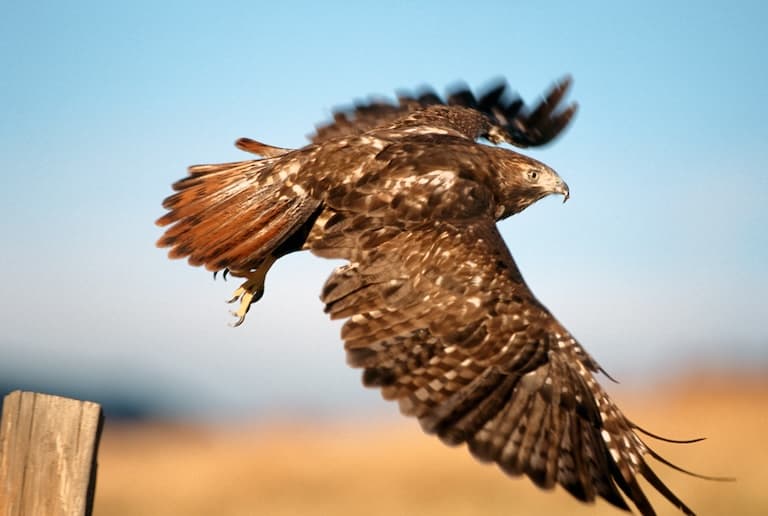
Red-tailed Hawk Fact-File Summary
Scientific Classification
| Kingdom | Animalia |
| Phylum | Chordata |
| Class | Aves |
| Order | Accipitriformes |
| Family | Accipitridae |
| Genus | Buteo |
| Species | jamaicensis |
Fact Sources & References
- “Red-tailed Hawk”, Cornell Lab.
- Colleen et al (2010), “Hawk Eyes”, National Library of Medicine.
- (2024), “Red-tailed Hawk”, The IUCN Red List of Threatened Species 2024.