
Six-eyed Sand Spider Profile
The infamous brown recluse has an even more mysterious cousin. A relative from before South America split with Africa, a spider who has remained buried in the sand, dotted about the Namib desert and just waiting for victims to wander by.
This is the six-eyed sand spider, and it’s a fantastic example of how, when left with a dearth of information, the internet will just make things up.
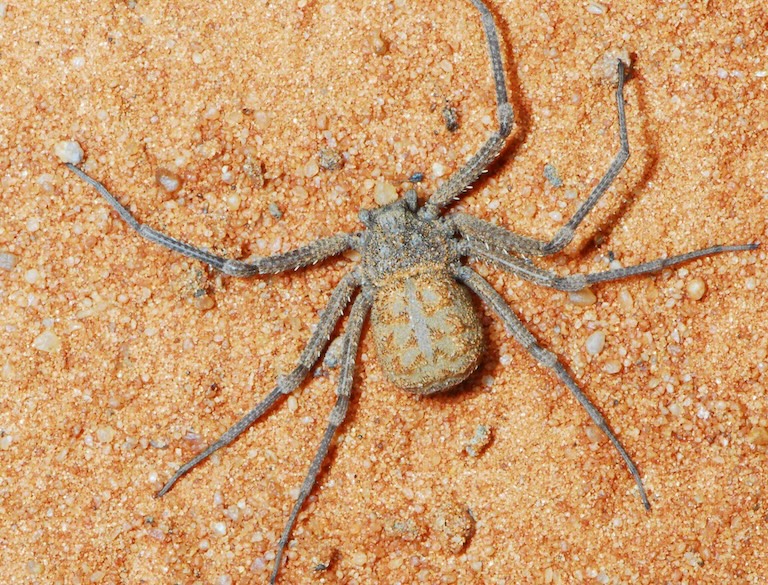
Six-eyed Sand Spider Facts Overview
| Habitat: | Deserts, arid, dry grasslands/shrublands |
| Location: | Southern Africa |
| Lifespan: | Around a year |
| Size: | Up to 40 mm (1.6 inches) |
| Weight: | Not listed |
| Colour: | Brown, sandy colouration |
| Diet: | Smaller invertebrates |
| Predators: | Birds, lizards |
| Top Speed: | Unknown |
| No. of Species: | 1 |
| Conservation Status: | Not Listed |
The six-eyed sand spider is genuinely a relative of the recluse, but it’s even more reclusive. Despite various headlines declaring it the most dangerous spider to have bite you, there are no confirmed cases of it ever doing that.
Still, this doesn’t imply that it’s by any means safe, and some cases where it’s a prime suspect have been fatal – they just haven’t been confirmed, yet.
In the meantime, enjoy the juxtaposition of this incredibly cute yet potentially horrifying animal.
Interesting Six-eyed Sand Spider Facts
1. They’re short-lived
This is a spider species that we know very little about. It seems everyone knows of it, but few people know much about it.
One thing we do know is that it doesn’t live very long, at least in captivity. Tarantulas, for example, live for up to 30 years in some cases; true spiders typically live far shorter, but usually in the realm of 2 to 5 years.
This little guy only lives for a year. This is a very short life, so you’d think it’s always in a hurry to get things done. But the six-eyed sand spider is, as we will explore, a bit of a scary mystery, even as spiders go. The two factors of being in Africa and being a spider reduce its popularity among those who fund research, so it has those handicaps already, but the way it lives poses a challenge, too.
2. They’re reclusive
This species lives in Southern Africa, and while there are loads of people down there, they tend to gather where there’s water, while this spider prefers places where there isn’t.
This preference for desert habitat makes them hard to come by, at least by accident, and explains why they’re so under-studied. But there’s more!
Sand spiders are, by name and nature, very reclusive. Because they are members of the Sicariidae family of spiders, known primarily from their New World member, the brown recluse. Recluses are so-called because they are good at hiding, and so our six-eyed sand spider not only lives out of the reach of people, but is also sneaky while doing it1.
Recluses are also known to be very shy, and like all spiders, don’t bite people unless they’re trapped. Or, in the case of some research, pulled at with tweezers by scientists trying to make them bite.
Unfortunately, trapping a spider is sometimes done by accident, and with the recluses, it can have serious consequences.

3. They’re possibly quite venomous
The days of animal testing are not yet over, but thankfully, they’re a lot better than they were. In the ‘70s and ‘80s, spider venom was studied by taking a nice fluffy bunny and forcing the spider to bite it, then logging the details of its miserable and often lengthy demise.
It’s much harder to get funding for that sort of thing now, which is unequivocally better, but it does mean that we don’t know as much about how potent a spider bite is until we find people who have been bitten by one.
Members of the same family of spiders as this one are regarded as highly potent and very damaging to blood and skin tissue, and for the poor rabbits, this resulted in lesions and difficulty moving and, within about 15 hours, death.
There isn’t much in the way of an antivenom for this group, either, so there’s an additional layer of risk, there.
But the six-eyed sand spider in particular isn’t specified as one of the test subjects, so we don’t know precisely how venomous it is, and being very reclusive, not many folks have been generous enough to go and get bitten by one.
What scientists do know about them, and intimately, is the condition of their genitals.
4. They have soft genitals
If you hang around people who study invertebrates for long enough, you’ll eventually discover that genitals are a keen focus. And while people who spend their lives inspecting spiders are undoubtedly paraphiles, this isn’t why.
At the scale that we’re dealing with when identifying insects and spiders and the like, species can get very difficult to tell apart, but one area in which tiny animals are the most starkly different from one another is their reproductive organs. And that’s because each species, almost by definition, is engaged in an evolutionary arms race between male and female, in which the genitals evolve almost independently of their environments. So, two very similar species can have very unrelated genitals.
Therefore, learning what their junk is supposed to look like is a very easy way of telling species apart. And in spiders, there are two general groupings: females with hardened genitals and those without.
Six-eyed sand spiders are members of the soft genital group. Which, as it happens, is quite common and nothing to be ashamed of.
5. They’re free-living
One great thing about escaping to the desert is that you can do whatever you want. And the sand spiders are not bound to webs or burrows or other arbitrary territories; they wander about the desert as they like.
These are terrestrial spiders, and are known for being able to rapidly cover themselves with sand, which is aided by special hairs on their legs and abdomens. When submerged, they can just stay put, waiting perhaps even for weeks, until something is unlucky enough to wander by.
So, as free and short-lived as they are, they don’t do a lot with it. Males will be seen roaming around during mating season, looking for females, but otherwise, they’re really not living up to their potential2.
At least they look good doing it.

6. They’re cute!
This might be a hard sell for arachnophobes, but there’s something very sweet about this tiny animal covering itself with sand.
Of course, it’s doing this so that it can burst out of the substrate and murder things, so it’s not all that cute if you’re on its menu, but we are not, so we have the privilege.
These spiders make low-maintenance pets for some of the more deviant animal lovers around us, but they’re not the kind of animal you’d play with.
7. Nobody really knows how dangerous they are
Spiders are a bit like mushrooms, in that their danger can be very difficult to judge without risking your life.
Six-eyed sand spiders, as we’ve discussed, are members of a family that’s well known for being quite toxic, though deaths are very rare. Tissue damage as a whole, though, and secondary infections that come with it, are the second layer of lethality after venom potency. This is likely what took the arm off a 17-year-old boy in Southern Africa in the ‘80s, while the blood damage alone was enough to kill the victim of the only other recorded bite.
The exact species of the perpetrator was never confirmed, but as with mushrooms, it’s best not to eat one unless you’re very sure it’s safe.

Six-eyed Sand Spider Fact-File Summary
Scientific Classification
| Kingdom | Animalia |
| Phylum | Arthropoda |
| Class | Arachnida |
| Order | Araneae |
| Family | Sicariidae |
| Genus | Hexopthalma |
| Species | hahni |
Fact Sources & References
- Gerald (1982), “Preliminary Report on the Medicak importance of Sicarius(Araneae : Sicariidae) and the Action of it’s Venom”, Butantan.
- Dippenaar et al (2021), “South African National Survey of Arachnida Photo Identification Guide: The Sicariidae of South Africa”, Zenodo.