
Racer Snakes Profile
It wouldn’t be much of a race if there were only one contender, so it’s highly appropriate that racer snakes are not a single species of snake, nor even a single genus!
Today, we’re looking at as many different types of racer snakes as we can fit into a single blog post, and we’ll go over what they have in common and some of the quirky differences, too.
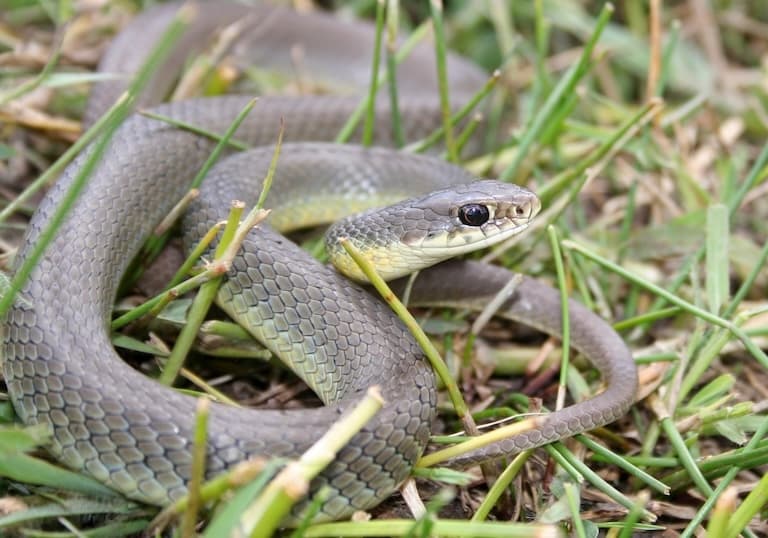
Racer Snake Facts Overview
| Habitat: | All terrestrial except polar |
| Location: | Worldwide |
| Lifespan: | Up to 25+ years |
| Size: | Up to 2.5 metres long |
| Weight: | Up to around 8 kg (17.6 lb) |
| Colour: | Varied, from green to brown or black, varied patterns. |
| Diet: | Generalist predators |
| Predators: | Birds, mammals |
| Top Speed: | Up to 16 km/h (10 mph) |
| No. of Species: | 30+ |
| Conservation Status: | Range from Least Concern to Critically Endangered |
Racers are some of the fastest snakes on land, which does make them pretty intimidating at first glance, but as colubrids, not only are they rarely venomous, but they’re also exceptionally shy and will do all they can to stay out of people’s way.
Being a diverse and unrelated group (beyond the family level), they are named mostly for being long and fast, so there is a lot of diversity within this category, too. This manifests in a range of habitat preferences, colouration and attitudes, with most being generalists, but all being remarkably good-looking animals. Sadly, while most of the generalists are doing very well, many of the highly specialised minorities are at imminent risk of extinction.
Interesting Animal Facts
1. They’re Colubrids
For all their differences, racer snakes of all types do appear to be contained within a single family of snakes. The Colubridae family also happens to be one of the coolest families of snakes, with some of its high profile memberships being handed out to the likes of the hognose snake and Boomslang, the latter being one of the most potently venomous animals on the planet.
But these dangerously spicy snakes are the minority among the colubrid family, as the vast majority are non-venomous, and those that aren’t are so shy that they rarely bite. And even if they do, they have a very inefficient delivery method, which brings us to their teeth.
Colubrids are rear-fanged snakes, which sets them apart from the more traditionally lethal snakes like vipers and cobras, who have their big death pins at the front of their mouths. So in order to envenomate, colubrids have to open very wide. On top of this, they don’t have hollow fangs, so they have to sort of chew their toxic saliva cocktail into a wound like a Komodo dragon.
This, as you’d expect, isn’t as efficient as the hypodermic needle approach of their relatives, and this may well be because Colubrids are basal to both vipers and Elapids. Som they’re ancient, too!
There are many species of colubrid known as racers, and most fit well within the “harmless” category. But they are fast.
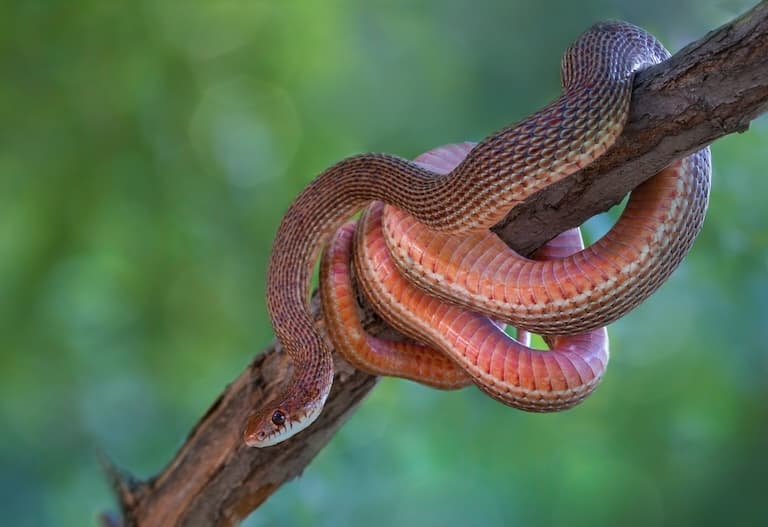
2. They’re fast
This is, of course, relative. We’re all spinning together on a big rock at 1600 km/h, and this itself is hurtling around the sun at 107,000km/h. The sun, of course, is orbiting a great big black hole at a rate of around 830,000 km/h, and Odin knows how fast that thing’s cruising. So it really depends on your reference point what you call fast.
But as far as snakes go, racers are pretty quick. They have been said to hit 16 km/h, which is a pretty fast jog, and up there with the black mamba for land speed. So, it’s a good thing they aren’t out to eat us.
3. There are many kinds
North America is absolutely plastered with Coluber constrictor, the Eastern, or North American racer. That’s one type, and quite a large snake at around 2 metres long, depending on which of the 11 subspecies it is.
Then, there are island racers, like the speedy little Galapagos racers that were made famous for chasing marine iguanas in Planet Earth 2.
There are 16 species in the Philodryas genus, commonly called racers, and these are South American snakes, and these ones are not as harmless as the family average. They are quite venomous and considered medically significant, but there are no obvious cases of any deaths occurring from their bites1.
4. They’re adaptable
Racer snakes are generally generalists, and this is probably the most starkly exhibited in the North American species which has split into at least 11 or 12 subspecies and dominates the continent.
Across these species, there are populations to be found in grassland, wetland, woodland and prairie, and pretty much anywhere with ground cover.
Since this isn’t a taxonomic group, however, it’s no surprise that there are exceptions to be found in pretty much any rule2.
5. But there are specialists, too
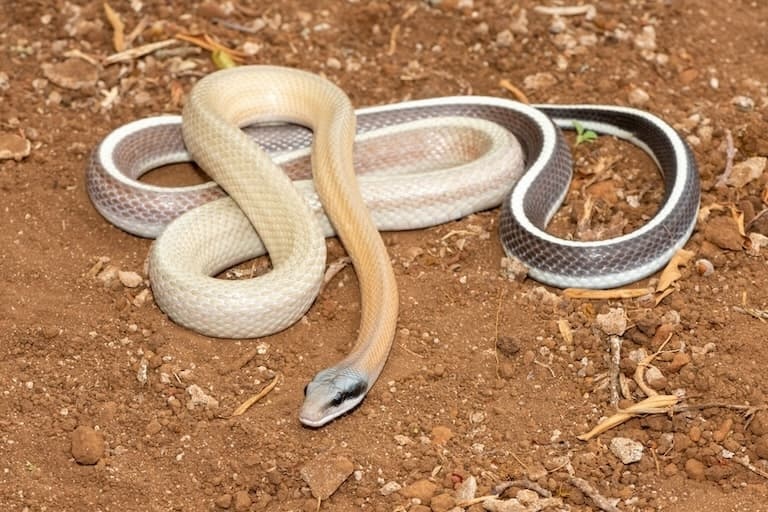
In the Dominican Republic, there’s a snake who sticks to what it knows. The Barahona red-headed racer doesn’t worry itself with all this wetland and grassland crap, and specialises in mid-elevation dry forests.
It does this to accommodate its specialised diet, which appears to consist of smaller snakes.
Sadly, as is often the case with specialists, this species is endangered due to the destruction of its habitat3.
6. They’re stunning
Colubrids are some of the best-looking snakes on average, already. And among the racers, there are some real supermodels
The red-tailed racer is a notable example, being that it’s emerald green with huge eyes and a vivid blue tongue and can be found hanging in trees in Southeast Asia. In the Philippines, these snakes sometimes have a yellow head, and the species grows to around 2.5 metres long.
This snake catches birds and bats by dangling into their flight path like a sticky rope. And it’s just one of many species of colubrid snake that’s incredible to look at.
7. Some are exceptionally rare
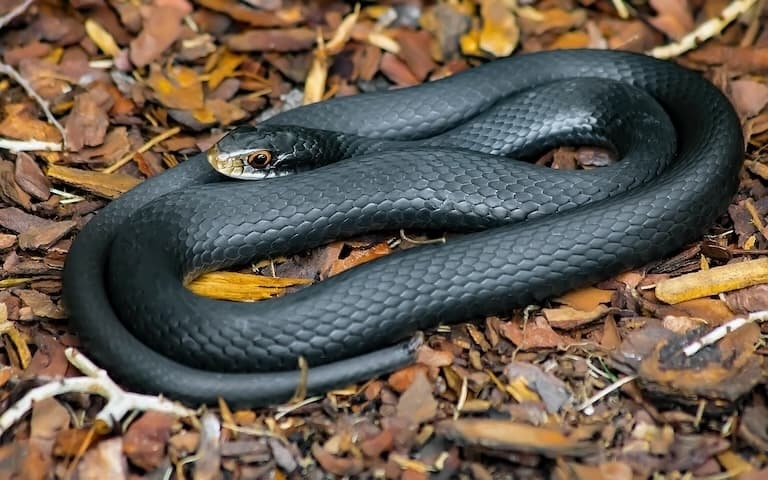
On the small island of St. Lucia, an Asian mongoose species was introduced that absolutely devastated the local snake populations. The species hit hardest was the Sount Lucia racer, Erythrolamprus ornatus, whose total number is now in the low tens to single digits as a result4.
This critically endangered snake has a woefully incomplete assessment record, and may well already be too far gone to save.
Racer Snake Fact-File Summary
Scientific Classification
| Kingdom | Animalia |
| Phylum | Chordata |
| Class | Reptilia |
| Order | Squamata |
| Family | Colubridae |
| Genus | Multiple |
Fact Sources & References
- Sanchez et al (2014), “Biochemical and biological analysis of Philodryas baroni (Baron’s green racer; Dipsadidae) venom”, Pub Med.
- (2018), “North American Racers and the Department of Defence”, Department of Defense.
- Inchaustegui et al (2017), “Barreras Fanged Snake”, The IUCN Red List of Threatened Species.
- Daltry (2016), “Saint Lucia Racer”, The IUCN Red List of Threatened Species.