
Red-crested Turaco Profile
In Western Angola, there’s a bird dressed up like a fruity sweet, hopping around like a little arboreal dinosaur, planting trees with its butt. This may sound like a character from a kids’ cartoon, and it’s almost as fantastic, for sure, but it’s a real animal. A member of the prettiest forest custodians, the turacos.
And in true turaco form, it’s gorgeous. This is the red-crested turaco, an animal that heads up the Turaco ecosystem services department for the Angola branch.
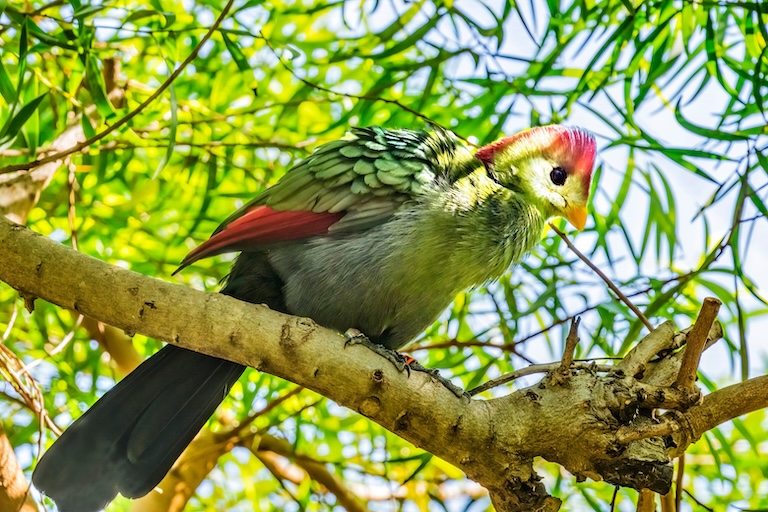
Red-crested Turaco Facts Overview
| Habitat: | Tropical forest |
| Location: | Western Angola |
| Lifespan: | At least 9 years, likely much longer |
| Size: | Up to 50 cm (20 in.) long |
| Weight: | Up to 325g (11.4 oz) |
| Colour: | Bright green with a pale face and red crest; blue tail feathers |
| Diet: | Fruits and berries |
| Predators: | Raptors, humans |
| Top Speed: | Slow |
| No. of Species: | 1 |
| Conservation Status: | Least Concern |
Red-crested turacos have a lot in common with the rest of the turacos: they’re medium-sized, brightly coloured fruit eaters with a great set of pipes. Their feet and their choice of outfit both tell us something about how they live, and their role in the forest is a critical one. Fortunately, the species is still doing well, and
Interesting Red-crested Turaco Facts
1. They’re banana-eaters
This is a technical term and doesn’t actually describe the feeding habits of this species! The family Musophagidae, where the turacos belong, translates to “banana eaters” and contains the very grey go-away birds (which now also contains the plantain-eaters). While they don’t all eat bananas, they pretty much all do eat fruit.
And they all look a bit like fruit, too, as the turaco branch of this family appears to have hogged the overwhelming share of the colouration. These are spectacular birds, found all over forested Sub-Saharan Africa, and they are typically very long-lived birds, too, with some species reaching close to 40 years in captivity. It’s not known how long they live in the wild.
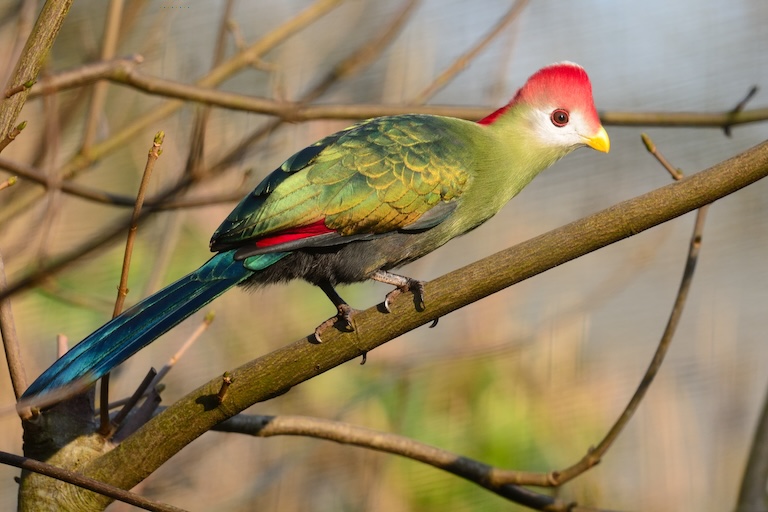
2. They have weird feet
Turacos have adaptable feet. While the toes of most birds pick a side – some at the front, some at the back – the fourth toe of the turacos can switch from front to back depending on the need. This makes the bird exceptionally agile in canopy environments, and this is where they shine. Literally!
Because turacos, including the red-crested turaco, are some of the brightest and most beautiful animals you’ll see in the forest. 1
3. Males and females look alike
Most often, when you get to see a very pretty bird, you’re looking at the male. Colouration in birds is commonly a way for males to show off that they’re healthy enough to gather a mixed and rich diet – enough to spare some of those nutrients to create pigment in their feathers.
Females, conversely, are often the drab ones. A female will sit around being entitled and picky, making the males dance about and prove themselves to her before she reluctantly decides to get knocked up by the least terrible of the lot.
But in red-crested turacos, and in all turacos, colours are expressed by both sexes. Males and females look almost identical (not to one another, apparently, but to us, at least), and both carry the exquisite decorative plumage that turacos are known for.
In this species, that’s a vibrant green, for the most part, contrasted against a stark red crest, long, blue tail feathers and white cheeks. Turacos are some of the most outrageous in their colouration, but they wear it so well. They’re elegant, striking, and they have haunting, beautiful voices, too. So, they’re essentially Stevie Nicks in Gold Dust Woman, but in bird form. 2
4. This is a clue
And there’s a good reason for this. Because while those drab females of other species are sitting about, casting bitter judgment over the failings of the hardworking males, they’re doing it because their investment later on is typically much greater. They’re the ones who have to incubate the eggs, feed the chicks, do the laundry, and still find time for a glass of Malbec at lunchtime on the veranda with the other suburbanites. Those hardworking males, by that point, are often working their tail feathers off to impress their next mate.
So, in species where the males are brightly coloured, that’s their half of the deal. But in these turacos, both males and females share that responsibility, which means there’s a more equal approach to mating, too. Both sexes are looking for a healthy partner to share genes with, and both have to be up to the task. The female will be out and about picking up food while the male sits on the eggs, and vice versa. This means the female doesn’t benefit from being as camouflaged, either.
Even more, these colours – particularly the reds and greens – are incredibly rarely found in pigment form in birds. So, turacos are some of the only true-green birds you’ll see.
5. They don’t fly all that well
Picking up the groceries for this species involves behaviours that are pretty typical of turacos in general. These birds are frugivores, which means they forage for all sorts of fruits and berries. And they do it with incredible grace!
They aren’t long-distance flyers, and not very fast, either. Instead, they’re highly adapted to hopping through the branches, which they can do incredibly well for an animal with only two legs. Watching these colourful birds leap from branch to branch without opening their wings even a little bit for support, you could easily be persuaded that they are dinosaurs.
Of course, technically, they are – all birds are. But these ones really look the part, too.
6. They’re critical to the forest ecosystem
All of this hopping about in the forest eating fruit isn’t just fun; it also fulfils a deeper role that every species has (especially us) in its ecosystem. For the turacos, a big part of this role is to spread fruit seeds around and help them grow.
Not only does swallowing the seeds allow the bird to carry them away from their parent tree, but they then deposit them in prime locations, wrapped in a package of bird guano fertiliser.
Red-crested Turaco Fact-File Summary
Scientific Classification
| Kingdom | Animalia |
| Phylum | Chordata |
| Class | Aves |
| Order | Musophagiformes |
| Family | Musophagidae |
| Genus | Tauraco |
| Species | erythrolophus |
Fact Sources & References
- Incredible Inverts & Other Animals, “An introduction to the Red crested turaco.”, YouTube.
- , “Sharing wildlife sounds from around the world”, xeno-canto.