
Red-eared Slider Profile
Not since the ‘80s has a group of tenacious testudines been so globally successful. Originating in the US, a subspecies of terrapin within the slider family has managed to infiltrate pretty much everywhere that isn’t below -50 Celcius in Winter.
This is highly unusual for a turtle and a testament to its versatility and breeding success, but it can come at a cost to the ecosystem. With a name like beach bar finger food, it’s the Red-eared Slider.
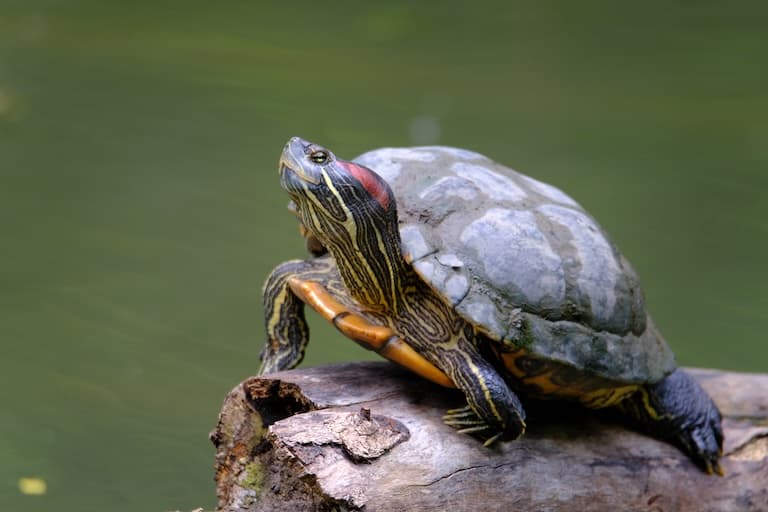
Red-eared Slider Facts Overview
| Habitat: | Freshwater and brackish environments |
| Location: | Southeastern and central United States and northern Mexico |
| Lifespan: | 41+ in captivity, around 30 in the wild |
| Size: | Up to 29 cm (11.42 in) long |
| Weight: | Up to 3.2 kg (113 oz) |
| Colour: | Greenish yellow to grey, brown, or black, with yellow stripes. Red marks on the sides of their heads. |
| Diet: | Generalists: aquatic plants and animals |
| Predators: | Alligators, birds |
| Top Speed: | Unknown |
| No. of Species: | 1 |
| Conservation Status: | Least Concern |
Red-eared sliders are a subspecies of a common American slider species, but one whose popularity as a captive animal has seen it spread into ecosystems on almost every continent.
This is good for the species, and for anyone who wants to ethically-justifiable turtle drumstics, but generally not for the ecosystems they’re dominating.
Interesting Red-eared Slider Facts
1. They’re a yellow-bellied subspecies
Red-eared sliders aren’t a species, but instead are a small offshoot of the yellow-bellied slider species Trachemys scripta. They’re listed as the subspecies, T. e. scripta, whose native North American range finds them in and around any number of various water bodies, wherever there is sunlight and the water isn’t moving all that much.
These turtles, then, are a low-maintenance lot, and this is the main reason they’re now doing so well for themselves. Their natural range extends down into Mexico, where they also occupy rivers, and they’re quite comfortable around human habitation, too1.
2. They’re clawed
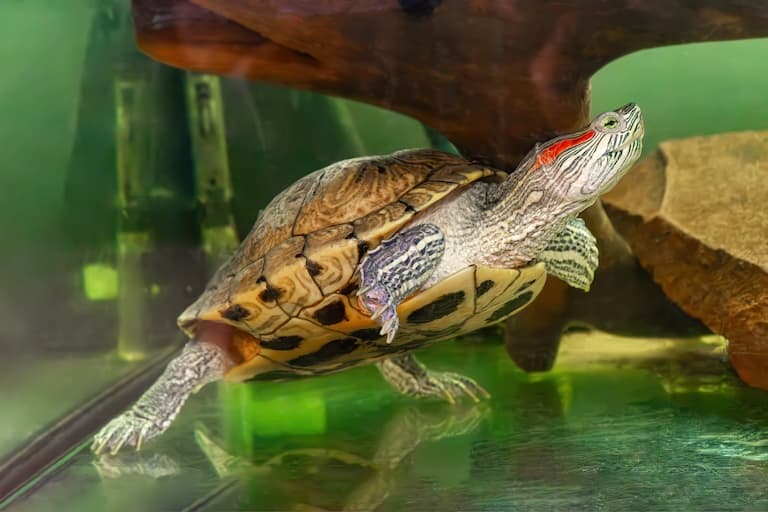
These turtles are highly aquatic animals, as is the norm, but unlike most, they have strong claws on their webbed feet. Males tend to have longer claws than females, but both sexes do have them, and they’re said to give you a nasty scratch if you let them.
These little turtles eat pretty much anything, too. So, for captive animals, they can be troublemakers if kept with fish. In the wild, they eat aquatic plants and invertebrates, but they will also hunt fish, for which the claws perhaps come in handy. This could explain why females and males both have claws, but the longer claws in males are evidence that this is a sex thing.
So, red-eared slider males will use their claws when mating, and this happens to be just one of the weapons of love employed by the species.
3. They like it rough
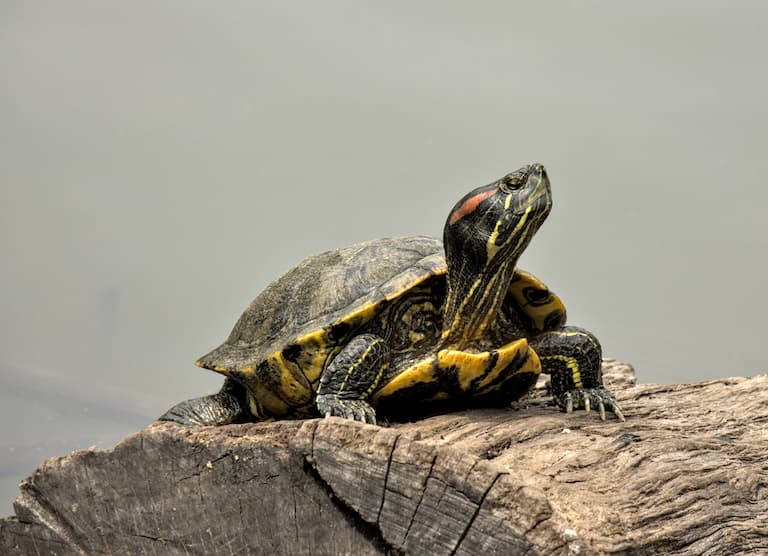
When a mummy turtle and a daddy turtle love each other very much, they will sometimes engage in a bit of sexy violence to keep things spicy. Courtship between males and females of this species involves playfully chasing one another around the bedroom, showing off how big the male’s claws are, and then, if all goes well, some biting and scratching.
Males vibrate their claws in front of the females to get them excited, which, thankfully, seems to be a necessary precursor to mating in most cases. Interestingly, different colour morphs have different rates of success here, with darker males employing lengthier titillation rituals and greener ones getting away with less2.
4. Temperature-dependent sex determination
Biologists love to condense long explanations into only slightly shorter terminology, and this is a great example of it. Temperature-dependent sex determination is a weird quirk of biology mostly seen in reptiles, in which the embryos of an animal come out more or less neutral, and the sex they develop into depends on the temperature at which they’re incubated.
“Hot girls and cool boys” would be a better summary if it weren’t for the fact that it can also be the other way around, depending on the species. In these sliders, though, this pretty much sums it up. Nests of red-ear eggs kept at 29.6 degrees will produce only females, and below 28.6 degrees Celcius, they’ll all be male. Any nest kept between these thresholds will be a mix.
5. They’re everywhere (almost)
So, this terrapin has a plethora of tricks up its shell to survive in a wide range of habitats, and this is exactly what it’s come to accomplish.
From humble beginnings in the stagnant pools of North American waterways, this red-streaked subspecies made its way into hobbyist aquariums all over the planet. And, when the owners inevitably realised how enormous and boring turtles are to keep, they allowed them to escape into the wilderness, setting up little colonies wherever they found water3.
They’re now found on every continent except Antarctica. And not all of them are welcome.
6. They are hard to swallow
These are slippery characters and hard to catch. Sliders are named for being able to slip away in a hurry, and this keeps them safe from predation in most instances. Their low-aspect shells also help protect them from their main natural predator: the alligator.
A large ‘gator has no problem popping a small turtle such as this, just like a grape, but a small to medium beast has a much harder time. Their slippery, hard bodies make it a task similar to picking up a well-worn soap in the shower. And this is by design—well, by evolutionary design, anyway—because it allows them to thrive even with alligators all around them.
7. They’re doing alright
So, all in all, this is a very successful subspecies. They’re listed as Least Concern, which should come as no surprise, and they are not at risk of going extinct any time soon. In fact, they’re the ones causing trouble for other species.
Populations in various parts of the world are causing all sorts of harm to the local ecosystems that didn’t evolve to tolerate such a voracious animal all of a sudden. Some populations are in the top 100 words on invasive species lists, and can and should be hunted to keep that under control, which makes their meat pretty ethical as far as animal protein goes4.
Red-eared Slider Fact-File Summary
Scientific Classification
| Kingdom | Animalia |
| Phylum | Chordata |
| Class | Reptilia |
| Order | Testudines |
| Family | Emydidae |
| Genus | Trachemys |
| Species | scripta |
| subpecies | elegans |
Fact Sources & References
- Dijk et al (2011), “Yellow-bellied Slider Turtle”, The IUCN Red List of Threatened Species in 2010.
- Armentrout and Mcgregor (2019), “Trachemys scripta”, Animal Diversity Web.
- (2025), “Red-eared slider”, Invasive Species centre.
- Dijk et al (2011), “Yellow-bellied Slider Turtle”, The IUCN Red List of Threatened Species in 2010.