
Red-eyed Tree Frog Profile
In the wet and drippy forests of Central America, you’re really spoiled for choice when it comes to pretty frogs. Costa Rica alone has around 150 species, including the blue jeans frog – also known by the mixed-message name of strawberry poison dart frog.
If you’re looking for a very pretty Central American frog to lick, don’t pick that one. But the red-eyed tree frog is still up for grabs.

Red-eyed Tree Frog Facts Overview
| Habitat: | Forests, wetlands: wet and humid areas, near water |
| Location: | Central America |
| Lifespan: | 8 years in captivity, 5 in the wild |
| Size: | Up to 7 cm (2.76 in) long |
| Weight: | Up to 15 g (0.53 oz) |
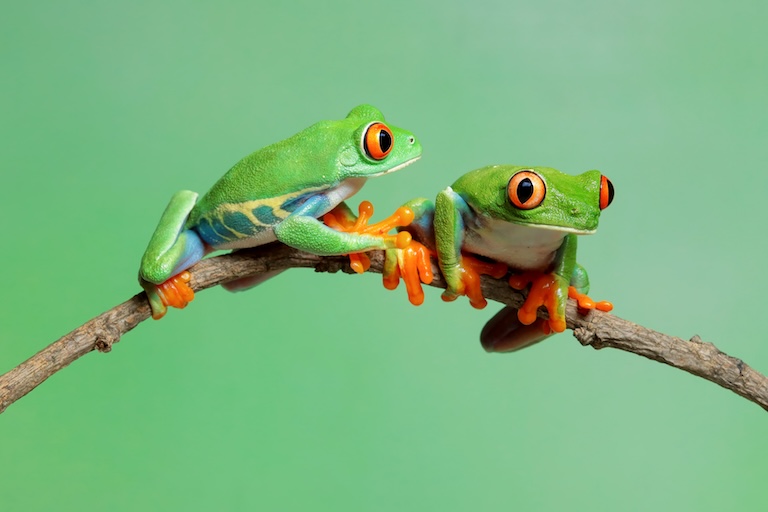
| Colour: | Green, with a light orange belly and red eyes. Sometimes they have blue limbs and flanks |
| Diet: | Mostly insects, also other frogs |
| Predators: | Wasps, snakes, crustaceans, spiders, birds and bats. |
| Top Speed: | Slow |
| No. of Species: | 1 |
| Conservation Status: | Least Concern |
Red-eyed tree frogs are members of the true tree frog group, but their official taxonomy differs a bit, depending on where you look. Regardless, these are stunningly pretty animals, especially for something that’s relatively edible, and rely on crafty alternative defences to protect them instead.
Despite a rapidly dwindling habitat, these frogs are still going strong, and hopefully that doesn’t change any time soon.
Interesting Red-eyed Tree Frog Facts
1. They’re Hylids, maybe
The family Hylidae is a very large and diverse one that contains all true tree frogs and a bunch of so-called allies. These allies are presumably frogs that don’t identify as tree frogs themselves, but share the belief that tree frogs are an equally worthy and naturally occurring variant of frog that just live a bit differently than most frogs. And that’s fine.
Anyway, tree frog and “treefrogs” are both acceptable nouns for these animals, and they often, as the name suggests, live in trees, rather than ponds. But this is a very large and diverse lot, so plenty of them don’t. Some are terrestrial, and some are pretty standard, semi-aquatic frogs. Still, the majority spend a lot of time outside of the water – more time than is common among frogs.
Two subfamilies are debatable: Pelodryadinae and Phyllomedusinae are considered by some to be their own families, and the red-eyed tree frog is in the latter. So, they’re either Hylids or they’re Phyllomedusinids, but either way, they’re legit tree frogs.
2. They’re excellent climbers
True to the name, these frogs are incredible climbers. They have those characteristic gummy discs on their fingertips that function like wet suction cups, and this allows them to clamber out of the water and up into the canopy.
They are most often found in the leafy understory of the tropical forest, but this might also be because that’s where the people who find them most often are, too. These frogs rarely need to touch bodies of water at all, at least as adults.
They even lay their eggs on leaves, rather than in the water, and the tadpoles have to hope they plop into water after they hatch. Fortunately, the embryos themselves are pretty smart.
3. They’re observant as embryos
Red-eye tree frog babies are baked inside a clear, gummy frog egg, and so they aren’t entirely in the dark. Once their little froggy brains are mostly formed, they begin to take in information from the outside world. This happens before they’re ready to hatch, as they pick up vibrations around them, and possibly images, too, to figure out if it’s safe to emerge.
This is a very neat little adaptation that protects the species in the absence of any of the debilitating toxins that so many of their kind have. 1
4. They’re not toxic
Licking frogs in Central America is a lot like visiting a soviet casino. Part of what makes the region so gloriously colourful is the sheer quantity of toxic animals displaying their defences in bright shades and patterns on their skin.
With their blue limbs, red eyes, and orange bellies, red-eye tree frogs certainly look the part, but this is all a ruse. There are many forms of mimicry in the animal kingdom, but when something harmless evolves to look like something dangerous, this is known as Batesian mimicry, and it’s exactly what’s going on here.
The bright colours of this tree frog evolved to make predators think twice before attacking, and it clearly works, or it wouldn’t have been passed on. But (as far as we know – don’t sue us) this species is perfectly safe to eat, lick, rub all over your body, etc. Just don’t do it with a live one; that would be cruel.
5. They have special eyes
Being non-toxic bluffers, the bluff itself is better used as a last resort. So, when resting, these frogs use their camouflage. They tuck in their brightly coloured legs, sit down over their orange bellies, and only present their green backs to the world.
Their red eyes would give them away immediately, so they cover them with a special membrane. This, of course, would plunge a lesser frog into darkness, unable to see predators approaching, but this species has a clever adaptation here, too. Its nictitating membrane is reticulated with a camouflaged pattern that breaks up the redness of the eyeball while still allowing light into the eye for vision. 2

6. Their homes are being destroyed
So, red-eyed tree frogs have adapted well to their environments, and are balanced against the threat of predation with all their clever defences. But they have nothing to protect them against the destruction of that environment as a whole, and this, then, is the largest threat to the species.
Deforestation and the degradation of the freshwater systems across their range pose a long-standing and ongoing threat to these frogs and the hundreds of thousands of species around them. The good news is that they are tolerant of disturbances, and in areas where logging is regulated and selective, they seem relatively unaffected.
They are going okay, for now, and are listed as of Least Concern, so hopefully, this is a species that can survive until we figure out widespread sustainable forestry. 3
7. They’re popular as pets
Another boon for the species is their popularity as pets. They breed in captivity, so there needs to be no impact on their wild populations, there.https://youtu.be/NCJj8lXNTAA?si=ps2C8oN0RqKHjo5a
Their low toxicity and stunning colouration make them popular in tropical terraria and as flagship species for forest conservation. 4
Red-eyed Tree Frog Fact-File Summary
Scientific Classification
| Kingdom | Animalia |
| Phylum | Chordata |
| Class | Amphibia |
| Order | Anura |
| Family | Hylidae or Phyllomedusidae |
| Genus | Agalychnis |
| Species | callidryas |
Fact Sources & References
- Amit Manjunath (2022), “Agalychnis callidryas ”, Animal Diversity Web.
- Abigail Beall (2014), “Smaug the dragon or frog with an eye to die for?”, NewScientist.
- (2016), “Red-eyed Treefrog”,IUCN Red List.
- Eileen Underwood (2025), “Breeding Red-Eyed Treefrogs”, Reptiles Magazine.