
Regal Jumping Spider Profile
In recent years, there’s been a surge in popularity for an unlikely group of animals: spiders.
Sadly, not all spiders – people are still a bit too spooked by most of them – but one group of very worthy critters known as jumping spiders has been the focus of widespread positive attention for the first time. Among internet-dwellers and cute pet animal lovers, it’s because of their big eyes and recognisable personalities, but among animal nerds like us, it’s also because these were found to be some of the most intelligent arthropods we’ve ever tested.
And today’s subject, the regal jumping spider, has all this, and more!
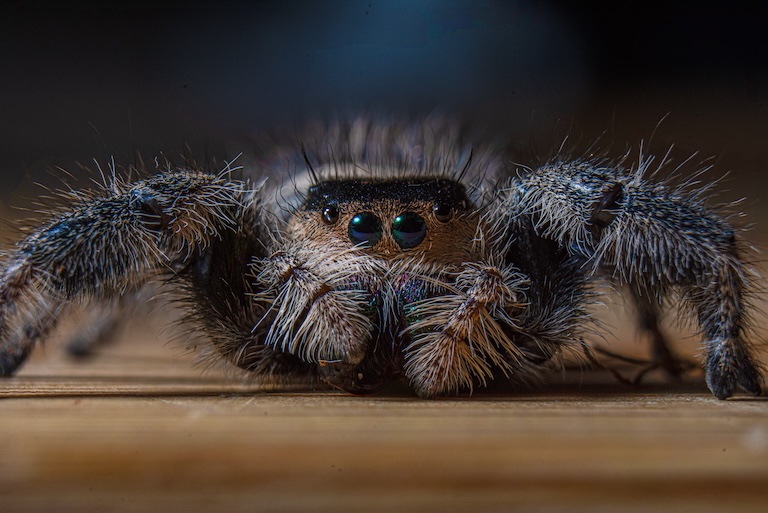
Regal Jumping Spider Facts Overview
| Habitat: | Open areas, meadows with a preference for palmettos |
| Location: | North and Central America |
| Lifespan: | Around 1.5 years |
| Size: | Up to 22 mm (0.87 in) long |
| Weight: | Unknown |
| Colour: | Females are grey-brown with red back and head, males are black with white flecks on abdomen and white tufts on legs |
| Diet: | Smaller inverts |
| Predators: | Birds, reptiles, wasps, frogs, other spiders, nematodes, mantises and flies |
| Top Speed: | Jumping speed of around 100 cm/s |
| No. of Species: | 1 |
| Conservation Status: | Least Concern |
Spiders would be rather divisive animals if they weren’t so universally hated. And this monkey-brained approach to wildlife is deeply disappointing, because not only are spiders super cool, but they’re paving the way for a revolution in understanding of non-human intelligence. Jumping spiders, in particular, are displaying a surprising level of cognition, previously overlooked.
Fortunately for them, and for those who study them, they’re also cute! So, we are remaining optimistic that animals like the Regal jumping spider can function as gateway species into the fascinating world of arachnids.
Interesting Regal Jumping Spider Facts
1. They’re true spiders
Spiders have been around for a long time. Potentially 400 million years, even. They make up an order of arthropods, somewhat related to the crustaceans, called Araneae. They generally produce silk and venom and are the largest order of arachnids around today.
They’re broken into three groups today, with the most ancient being a single family of spiders in the suborder Mesothelae; the tarantulas in the suborder Mygalomorphae; and the so-called “true spiders” in the Araneomorphae suborder.
This latter group houses the majority of spider families, and can be differentiated by the angle of their fangs, which point toward one another.
Jumping spiders are a single family within this suborder called Salticidae, but a big one! There are more than 700 genera here, with over 6,000 described species. In fact, this is the largest spider family known. And they have so much to teach us!
In the Phiddipus genus, there are around 76 or so species of cute little murderers, and the regal is just one of them. But, as far as North American spiders go, it’s a monster. At up to 1.8 cm long, it’s one of, if not the largest, North American species of jumping spider. And it’s a cutie.
2. They’re super cute
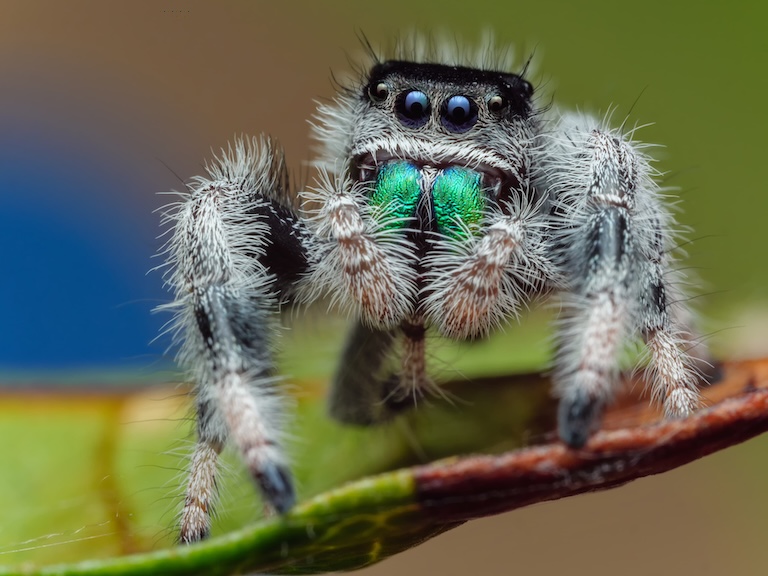
Jumping spiders like the regal are becoming popular because people have realised how cute they look. This cuteness comes from their habit of waving their little arms around, being covered in colourful hair-like strands, and having adorable faces with big, shiny eyes that appear to look up at you like that cat in Shrek.1
These traits all combine to make what is a very awww-inspiring animal, but they didn’t evolve to make us feel all fluffy inside – much like the sweet little house cat, the jumping spider’s cuteness comes as an unintended side-effect of its lethality as a predator. 2
3. They’re active hunters
Unlike most spiders, the jumping spiders aren’t content to sit and wait. They venture out, away from the mundanity of a web trap, and into the dynamic world of meadow ecosystems. Out here, this is a mini analogue of the African savanna – there are predators, prey, weather systems and all the unpredictability you don’t get from building a web in the corner of an attic.
Like all jumping spiders, the regal is an active hunter. It climbs, it leaps, it traverses, and it stalks, using the very traits that make it cute. The pretarsus, which are basically its toes, are highly specialised for uneven surfaces. They have retractable claws that allow them to climb on almost anything, and are so specialised to rough textures that a smooth surface is the one thing they struggle with.
They have bright colouration, often to hide in the grass, and then they have those enormous, binocular eyes on the front of their faces. These paired eyes are the best eyes of any arthropod measured, at least when it comes to visual acuity, and are sharper than many mammal species, too. They have precise depth perception, great colour vision, and they’re backed up by even more eyes on the sides, designed to specialise in motion detection.
The front two eyes can also look around, which is unsettling to think about. Unlike our eyes, which we have to swivel in their entirety to scan our surroundings, jumping spider eyes are fixed in place, but the retinas themselves are attached to muscles and can swivel in secret behind the lens.
This is a frighteningly precise killing instrument, and fortunately for us, it’s very small, because the jumping spider isn’t a mindless killer, like the frog or the owl – it comes with brains. This inconspicuous peeking is a great symbol of many of the hidden talents that jumping spiders hint at. 3
4. They’re incredibly smart
Historically, our species has been humbled continually, each time we thought we’d figured out how we differ from other animals.
Our intelligence remains our strongest bragging right, but even that’s now coming into question. With the early twinkling of an enlightenment on the horizon, nothing is more significant a threat to our egos than the concept of arthropod intelligence, and no arthropod is closer to humiliating us than the jumping spiders.
Early behavioural tests over the last decade or so, showed remarkable learning ability in Phiddipus species, and ongoing studies are exposing a hidden world of brain power in our tiny, ancient friends. The regal jumping spider, being an American species, and being quite a large one, is a primary case study in this, and has been shown to exhibit individual recognition and personality traits in relation to other individuals. This is a sign of long-term memory, and is just one of many ways that jumping spider intelligence has surprised us recently.
These spiders have object permanence, can employ dynamic hunting strategies, and will quickly learn which items taste good and which don’t. They are curious, charismatic and have so much potential to blow the doors to invertebrate cognition wide open. If only the funding were available! 4
Fortunately, they are also gaining wider popularity as pets.
5. They’re easy to care for
There are actually two other ways this species is likely to turn the tide of wider appeal in favour of certain spiders. As well as being cute, they’re also great pest control in gardens and on farms.
But the regal jumping spider in particular is a very easy animal to keep in the home, and allows people to get up close and personal with the depth of character present in jumping spiders.
Regal jumping spiders aren’t fussy eaters, and don’t require much in the way of maintenance, either. Fruit flies, crickets, mealworms and other feeder insects are readily available, and given enough matter inside the terrarium, they will easily be able to express all their natural behaviours from the safety of a small desktop tank. 5
6. They’re athletic
Now, we get to the killing blow and the origin of its name. Jumping spiders, as we all know, jump. And they do so spectacularly.
P. regius, again, has been the worthy subject of studies into this, as well, and has shown that they don’t use the old ratchet-style of energy storage to jump, as we see in things like fleas and snapping turtles, but instead use a coordinated series of muscle contractions, just like we do.
Only, theirs are way better.
Not only are they incredibly fast – fast enough to surprise a fly, ten body-lengths away – but they’re also calculated. Regal jumping spiders have been seen optimising their trajectories depending on the context of the jump, and figuring out the best angle from which to strike. 6
7. They’re venomous
And, when they land on their victim, they are spiders, after all. Like all spiders, this species is venomous. And as cute as it might appear, it is a precision predator with a deadly bite.
It’s not clear how dangerous this venom is to humans, though the lack of evidence despite its widespread appeal does suggest not very. Whether that’s because it doesn’t bite or because bites are ineffective, remains to be seen.
Some suggest the regal jumping spider’s bite is no more severe than an itchy mosquito bite, but there’s always the possibility of an allergic reaction to venoms, so best not to take a chance.

Regal Jumping Spider Fact-File Summary
Scientific Classification
| Kingdom | Animalia |
| Phylum | Arthropoda |
| Class | Arachnida |
| Order | Araneae |
| Family | Salticidae |
| Genus | Phiddipus |
| Species | regius |
Fact Sources & References
- Jumping Spooders, “Happy Jumping Spider-Phiddipus Regius”, YouTube.
- r/aww, “Meet the Phidippus regius, also known as the Regal Jumping Spider! They’re one of the smartest and friendliest invertebrates on the planet! ”,Reddit.
- Rößler et.al (2022), “Regularly occurring bouts of retinal movements suggest an REM sleep–like state in jumping spiders”, National Library of Medicine.
- Dahl et. al (2025), “Individual recognition in a jumping spider (Phidippus regius)”, eLife.
- Nicholas Spiller (2024), “Regal Jumping Spider Care Sheet”, Exotics Source.
- Nabawy et.al (2018), “Energy and time optimal trajectories in exploratory jumps of the spider Phidippus regius”, Scientific Reports.