
Reed Frog Profile
Everyone knows about the wonderful tree frogs you can find in South and Central America. The red-eye treefrog from Costa Rica has found its way into various company icons, and even had an office admin job in Bojack Horseman.
But a little lesser-known, as is often the case, are their African equivalents. Reed frogs are a genus of so-called bush frogs, and these pretty little things provide the deafening soundscape to any evening spent within 10km of freshwater in Sub-Saharan Africa.
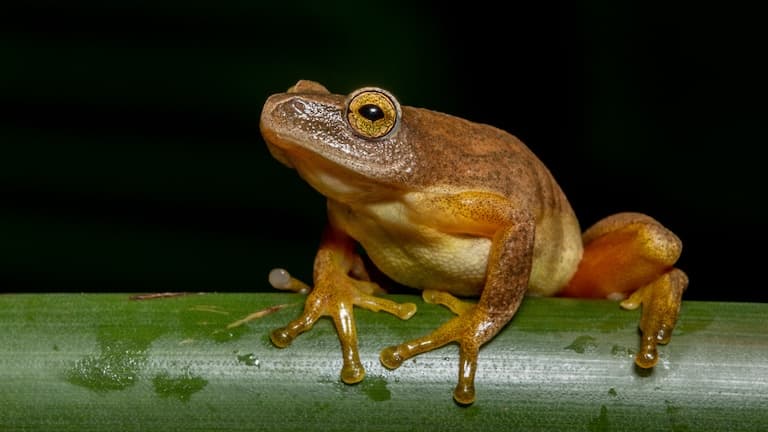
Reed Frog Facts Overview
| Habitat: | Humid forests, swamps, rivers, marshes, and urban areas near water |
| Location: | Sub-Saharan Africa |
| Lifespan: | 5+ years |
| Size: | Usually around 3cm to 5 cm (1.2 to 2 inches) long |
| Weight: | Around 2 grams |
| Colour: | Very varied, even within a single species! From plain to patterned and brightly coloured |
| Diet: | Smaller animals |
| Predators: | Bats, snakes, spiders, crocodiles, birds, other frogs |
| Top Speed: | Slow |
| No. of Species: | 150+ |
| Conservation Status: | Most Least Concern, some Vulnerable, several Critically Endangered |
Reed frogs are small but mighty animals, dotting the trees, grasses, doorways and rooftops of pretty much every African country south of the Sahara. They are spectacular little frogs with tremendous pipes, stunning variation in colour and the controversial ability to change sex when they get bored.
Interesting Reed Frog Facts
1. They’re bush frogs
Commonly, tree frogs are restricted to a single family of New World frogs and are pretty much all found primarily in the Americas. But as we are beginning to realise, evolution produces analogues of pretty much anything, when given the same environment, and so in Africa, there is a totally unrelated family of frogs that does pretty much the same thing.
In Africa, they’re not always called tree frogs. The Hyperoliidae family have several names, from tree frogs to bush frogs, to sedge frogs, and like their American counterparts, some do live in the trees, but many also live on anything else as well. There are around 19 genera of these described, and they’re all small frogs, no more than 8cm in the largest of them.
Within the bush frog family, there’s a single genus that’s densely populated with at least 150 species. These are the so-called reed frogs. This is the genus Hyperolius, from which the family gets its name, and they, too, live in all sorts of habitats as long as they’re humid.
The total number of these frog species is hard to figure out, and this is in large part because they’re so varied in colour.
2. They’re stunning
There are loads of these little guys to be found all across the humid regions of Sub-Saharan Africa. Which, as it happens, is most of it. And you’d think that being varied in colour would help the situation, but unfortunately, these frogs don’t agree on which colour an individual should be, let alone a species.
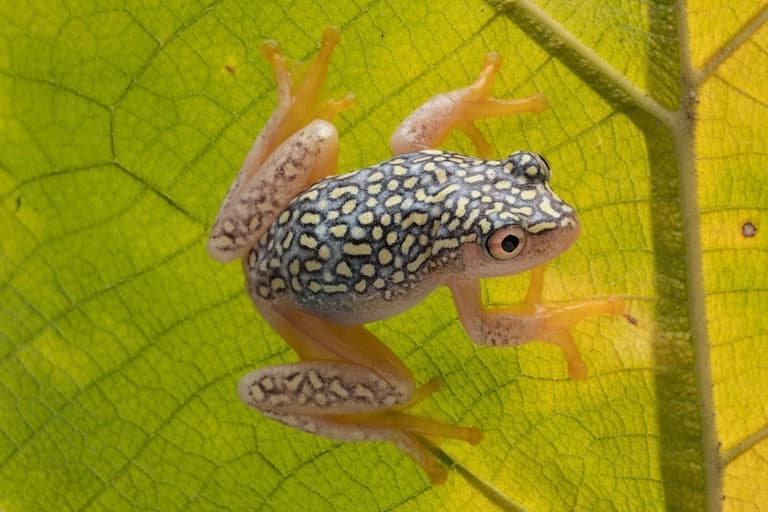
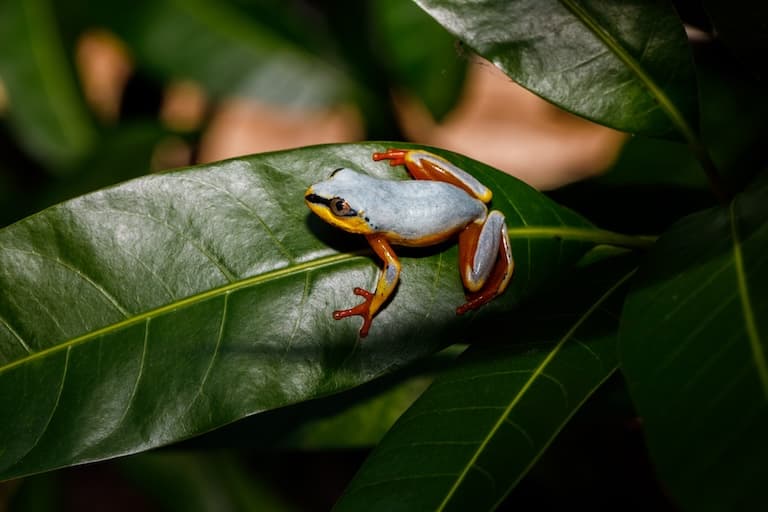
One species, the common reed frog, has around 50 recognised colour variations. Males are a different colour to females, and to make things more complicated, they can change colour, too. So, depending on the weather, temperature, which season it’s in, or which song you just played, this frog could be any number of different shades.
And branching out into other species, the colouration becomes truly incredible. Like the poison dart frogs, these little amphibians have stark colouration, dull colouration, patterns, stripes, blotches, and everything in between1.
The only thing louder than their colours is their voice.
3. They’re loud
An individual reed frog typically makes a very tiny clicking noise. This varies between species, of course, but usually within a recognisable range.
When slowed down, this proves to be a very short whistle, at around 0.1 seconds in length. Audibly, it rings out like a little glass bell, and on its own, it’s very cute to listen to. But these frogs are rarely alone, and once they get started, each of these individual tinks blends together into a sustained scream that rings out from the grass.
Females select for loudness and rate of tinking, and the sounds are also a way for males to spread out and give each other enough space to shout2.
4. They can change sex
It appears that Jurassic Park planted the seed in the public consciousness that frogs can change sex. In reality, this isn’t really something frogs generally can do, and is much more common in fish, molluscs and crustaceans.
Some even reject the idea that frogs can do it at all, which seems a bit silly, since it’s been documented in at least one species in this genus. These were captive frogs, but if they can do it in captivity, there’s no question they can do it in the wild, too. How often it happens remains a mystery3.
Still, it is apparent that at least some reed frogs can change from female to male after reproducing. Given the energy expenditure involved in pushing out hundreds of offspring, you can hardly blame them.
This is still very uncommon in frogs, as is the colour differential between males and females that we mentioned before. So these are special little critters, and as confusing as it all appears to us, they seem to have it figured out.

5. They’re fast breeders
Females really do get rather busy when it’s time to breed. They can produce a new batch of eggs every 2 to 3 weeks. This is one perk of not having to grow them to full ripeness inside the body, but it’s still quite resource-intensive.
There’s a bit of a rush to do this, as much of their habitat experiences stark contrasts in water availability between dry and wet seasons. And it’s all for the babies, of course, since the adults, in most species, rarely return to the water at all.
6. They stay out of the water
Reed frogs are experts at maintaining their moisture balance. Or, at least, the salt concentrations within it.
In humans, once water has been passed onto the bladder, there’s no turning back. We can’t, then, claim some of it back when we get thirsty, and we must pee it out, even if we find ourselves suddenly out of water to drink. But reed frogs can and do pass water back into their bodies from the bladder, and using this clever strategy, they can maintain a healthy osmotic balance in their tissues.
They can lose up to 55% of their bodyweight in water and still keep their water balance in check. Their skins are permeable, like all frogs, so being able to restore evaporated water by returning some from the bladder is how they manage to stay away from water for so long4.
As such, they can be found climbing all over most things and thrive in a number of habitats.
Unfortunately, habitats for wildlife all across Sub-Saharan Africa are shrinking.
7. Many are dying out
Despite the cacophony of reed frog calls to be heard, there are several species that are in serious trouble.
Habitat destruction is rampant with the rise of livestock farming, wood extraction and human settlements, and marshes and swamps are being drained all over the continent.
This reduction in living space for the frogs is being felt most painfully by the less populated species, such as the São Tomé Giant Reed Frog, from the tiny island nation of São Tomé. This pretty little dude is one of the largest reed frogs at 4cm long, and lives on a small island off the coast of West Africa, so it has nowhere else to go5.
It’s currently listed as Critically Endangered and in decline.
Reed Frog Fact-File Summary
Scientific Classification
| Kingdom | Animalia |
| Phylum | Chordata |
| Class | Amphibia |
| Order | Anura |
| Family | Hyperoliidae |
| Genus | Hyperolius |
| Species | 150+ |
Fact Sources & References
- “Common Reed Frog”, Curious Species.
- Jessica (2003), “Hyperolius marmoratus”, Animal Diversity Web.
- Copeia (1989), “Protogynous Sex Change in the Reed Frog”, Linsenmair_Protogynous.pdf.
- Schmuck and Linsenmair (Year), “Regulation of body water balance in reedfrogs”, ScienceDirect.
- (2020), “São Tomé Giant Reed Frog”, The IUCN Red List of Threatened Species 2020.