
Ring-necked Pheasant Profile
Britain isn’t the sensible first choice for anyone looking for bright, beautiful anything, let alone birds, but there are some exceptions.
Among them, a glorious relative of the chicken that runs around farmland making cool drumming noises and looking like a proper prince. Unfortunately for Britain, though, the ring-necked pheasant is not a native and had to be imported from a place with better birds.
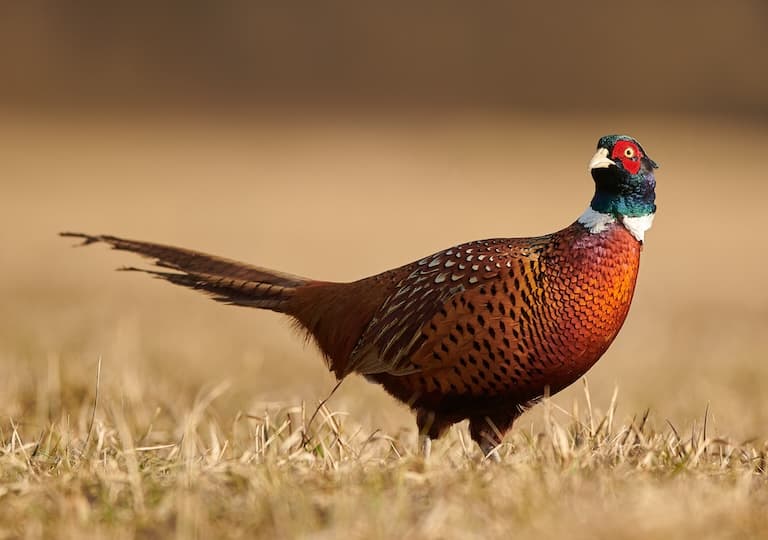
Ring-necked Pheasant Facts Overview
| Habitat: | Grass and stubble fields, ditches, hedges, marshes, and tree stands or bushes for cover. |
| Location: | Eurasia |
| Lifespan: | Up to 18 years in captivity; 3 in the wild |
| Size: | Up to 53.6 cm (21 inches) long |
| Weight: | Around 1.3 kg (44.5 oz) |
| Colour: | Males are iridescent copper and gold, with a red face and white collar. Females plainer, mottled brown |
| Diet: | Grain, seeds, shoots, and berries, as well as insects and small invertebrates. |
| Predators: | Foxes, dogs, mustelids, raptors, raccoons |
| Top Speed: | Unconfirmed up to 64 km/h (40 mph) |
| No. of Species: | 1 |
| Conservation Status: | Least Concern |
Interesting Ring-necked Pheasant Facts
1. They’re Galliformes
Among birds, there are the wet ones, the squawky ones, the chirpy ones, the ones with the big eyes, the ones with the long necks, and the thick, booming ones. There is some overlap in these groupings, and most taxonomists don’t use those particular terms much in formal discussion, but that’s the gist of it.
Among the thick booming ones, we find the turkeys, grouse, chickens, peacocks and such. These are members of the Galliformes order, whose closest relatives are the thick, wet ones – the ducks and geese (These two orders make up what are known as fowl). The majority of the Galliformes are in the Pheasant family, Phasianidae, which is, unsurprisingly, where the ring-necked pheasant is, too.
Pheasants make up several genera in this family, but they’re not a strict group of their own, so the name pheasant is a common word, rather than a phylogenetic description. The relevant genus, Phasianus, contains the Common pheasant and the green pheasant, and while the Japanese green pheasant looks like it would be right at home in Sherwood Forest, it’s the common pheasant that has been imported to Britain.
Within the common pheasant species, there are up to 30 subspecies in several groups. One of these groups of subspecies is called the ring-necked pheasants, on account of the white stripe on their collar.
This group name has become the common name for the species as a whole in the US, but these birds are not native to the US, either.
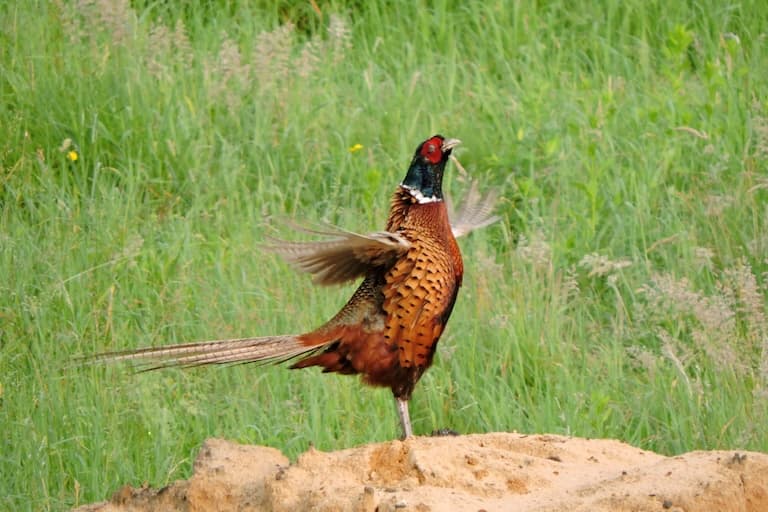
2. They’re Asian
Just like the cuisine, if you’re looking for anything memorable among British birds, the Asian imports are where you’ll find it. The invasive Leiothrix, the feral rose-ringed parakeet, and this guy: the ring-necked pheasant, are all of Asian origin, and some more welcome than others.
This is actually a Eurasian species, and is widespread across much of Asia, as well as the Southeast of Europe, natively. This range extends from the Caspian Sea, across most of Central Asia and into China, and down into Korea, Japan and Myanmar.
This is a sedentary bird that doesn’t migrate, so this range is pretty impressive, but since it became such a popular animal, it’s been introduced into Western Europe, North America, New Zealand, Australia and Hawaii, too1.
3. They eat anything
Being relatives of chickens, the pheasants share similar dietary preferences. Or, rather, lack of them.
These look a lot like seed-eaters, and potter about in croplands maintaining this image, but really, pheasants are just at home pulling apart lizards, or hunting for insects as they are scoffing grains.
Grassland and farmland, then, are perfect habitats for these birds as they provide all sorts of foods, and this lack of fussiness also allows the birds to thrive in most habitats.
The one thing they don’t seem to like is tree cover, and this might have something to do with the potential threats from above – pheasants are far more likely to spot and avoid raptors if the sky above them is clear.
But of all the animals to worry about, it’s humans who hunt pheasants the most.
5. It is one of the world’s most hunted birds
As we mentioned, pheasants in Britain and even much of Europe were brought over from Asia, and this didn’t happen any time recently. In fact, they might have begun shipping these birds in, as far back as 100 AD.
Back then, much of Britain was a very Italian place, full of Romans. These Romans enjoyed the look and taste of the pheasant, so they kept them around until they got the boot in around 380 AD.
It looks like pheasants disappeared from the Isles too, until some pesky Frenchman shot the king in the eye with an arrow and moved in to take over the country in 1066. The Normans brought with them more pheasants, and since then, they’ve been all over the place.
Hunting in the Middle Ages was a huge deal in Europe, and vast swathes of land were stolen from the peasantry and restricted as hunting grounds for the toffs. And pheasants have been one of the top draws for hundreds of years.
Today, they’re still one of the most hunted birds in the world, since this sport extends all the way back into their native range in Asia, too.
6. Which is keeping it safe
Ironically, the desire to hunt pheasants is precisely what keeps them in such great numbers. Captive birds are reared safely in pens, then released for hunters to nab as many as possible, and the rest are left to occupy the wilds as they like.
This means that the ring-necked pheasant, and the common pheasant as a whole, is listed as Least Concern, and not likely to go extinct any time soon.
In their native range, they’re just so adaptable and widespread that even with less regulated hunting efforts, they’re not in imminent danger of disappearing.
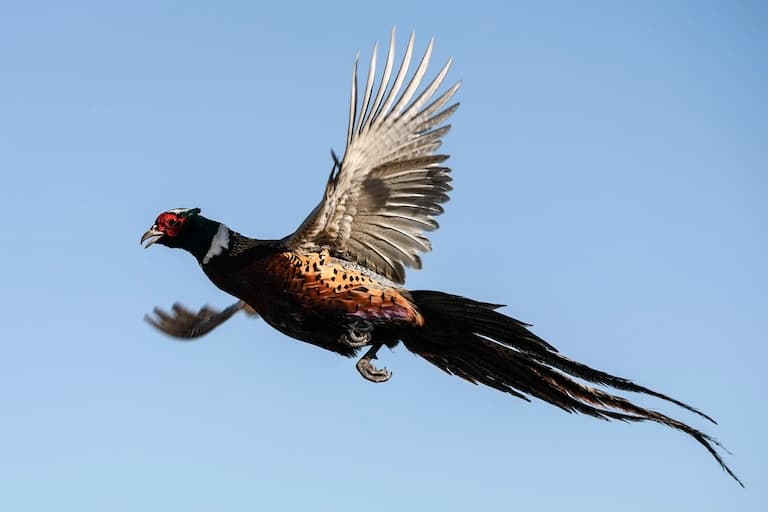
7. They might have become naturalised
Several things can happen when a foreign animal is introduced to an ecosystem. Most of the time, one of two things happens: either the animal quickly dies out because it didn’t evolve to survive in that ecosystem of that kind, or the ecosystem is destroyed because it didn’t evolve to survive an animal of that kind.
In the latter case, the species is considered invasive. But not all surviving invaders become invasive. Some, like this pheasant, become naturalised. The ecosystem adapts around them, they adapt around the ecosystem, and things remain relatively stable. This is, of course, how almost everything got everywhere at some time or another, so it can work.
Some studies suggest the pheasant may even benefit the ecosystem more than it harms it, but critics have pointed out that this may well be because of the hunters’ protection efforts to support areas with pheasants in them. Still, since hunters are part of the ecosystem too, it counts2.
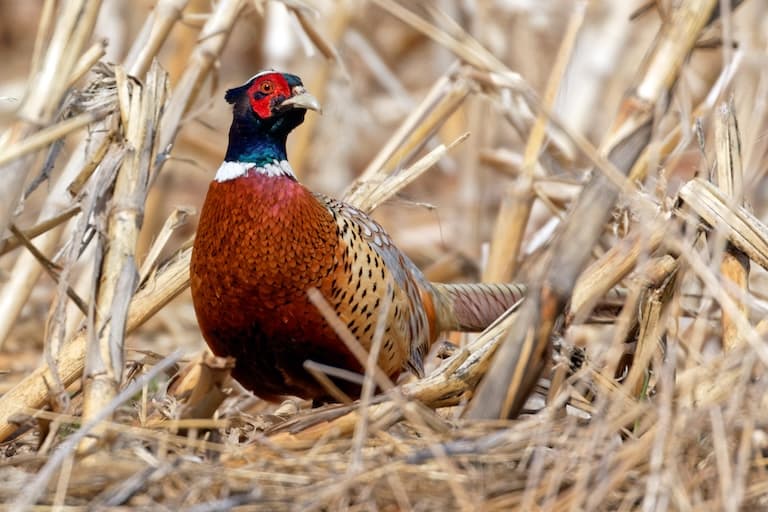
Ring-necked Pheasant Fact-File Summary
Scientific Classification
| Kingdom: | Animalia |
| Phylum: | Chordata |
| Class: | Aves |
| Order: | Galliformes |
| Family: | Phasianidae |
| Genus: | Phasianus |
| Species Name: | colchicus |
Fact Sources & References
- Switzer(2011), “Phasianus colchicus”, Animal Diversity Web.
- , “Woodland creation and management for pheasants”, WoodLand Trust .