
River Dolphin Profile
In the local folklore of the Brazilian Amazon, there’s a tale of the incredible shapeshifting capabilities of a local aquatic mammal, who, at night, comes onto land disguised as a man and seduces women for some reason.
In some areas, this is the Bufeo Colorado; in others, it’s Boto Cor-de rosa. But whatever the name, this legend refers to the river dolphin, an animal found only in a handful of places, with only a handful of species left. An animal whose rarity and charisma may not be enough to moisten the drawers of most human women, but certainly does get conservationists excited.
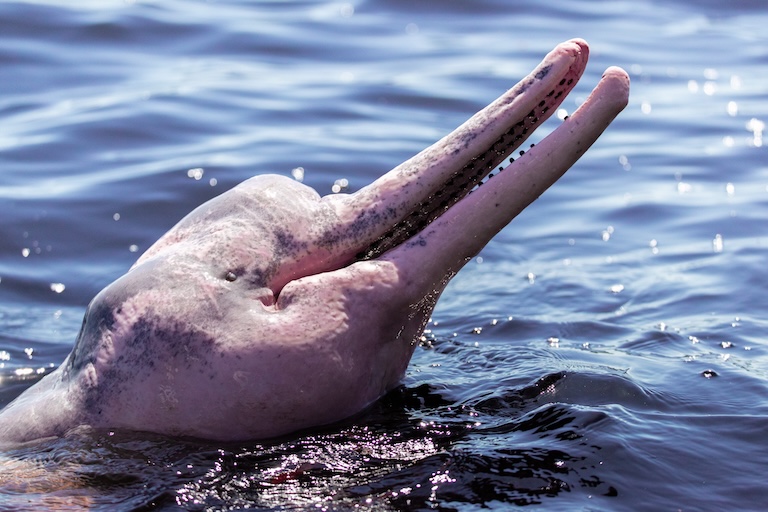
River Dolphin Facts Overview
| Habitat: | Freshwater or brackish water |
| Location: | South America and Asia |
| Lifespan: | Up to 30 years |
| Size: | Up to 2.4 metres (8 ft) |
| Weight: | Up to 150 kg (330 lb) |
| Colour: | Greyish, sometimes pink |
| Diet: | Fish |
| Predators: | Humans |
| Top Speed: | Fast |
| No. of Species: | 5 |
| Conservation Status: | One species is functionally extinct; two are endangered, one vulnerable |
River dolphins may not be a single taxonomic group, but they’re some of the most basal cetaceans you can find, and have inspired all sorts of myths and legends in our species, in their time. These ancient cetaceans are highly specialised to the cloudy waters of estuaries and rivers, and have adjusted by fine-tuning their sense of hearing, but this speciality is now being challenged, as our boats pollute their home with deafening noises and make it hard for them to hunt.
Interesting River Dolphin Facts
1. They’re paraphyletic
Cetaceans are, surprisingly enough, ungulates of the order Artiodactyla, which includes cows and sheep, goats, and deer and pretty much every large herbivore on four legs that isn’t a horse, rhino, tapir or elephant.
At some point, around 50 million years ago or so, a small group of these ungulates experimented with being semi-aquatic, probably in India. Since the Cretaceous extinction event wiped out all the sea monsters, there were no longer mosasaurs to worry about, and so this semi-aquatic lifestyle became fully aquatic, and Cetaceans took over the oceans.
About 30 million years ago, there was an argument over whether eating krill and singing to one another over vast distances was better than being able to see in the dark with sonar and kill stuff, and the cetaceans split into the baleen whales and the toothed whales.
Toothed whales today consist of the sperm whales, the beaked whales, the porpoises and the dolphins. So, dolphins are whales, and most of them live in the ocean. Orcas and bottlenose dolphins are members of the salty group, but there are several that evolved to live in estuaries and rivers, too, and here we find the six species of river dolphin. They’re not all related, though, so river dolphin is a very casual grouping that isn’t taxonomically based.
There are four families that have river dolphins, and they’re all generally pretty tiny.

2. They’re small
Bottlenose dolphins may be cute, but they’re also enormous, 650 kg predators. And orcas can grow to over 4 tonnes and eat great white sharks. So, when we say the largest river dolphin weighs up to 180 kg, this is a small animal, relative to its marine cousins.
And that’s only the largest species, the boto, or Amazon River dolphin; the smallest species, the La Plata, tops out at around 50 kg, and is unfathomably cute in the process.
River dolphins are found dotted about in South American and Asian rivers and estuaries, and not out in the open ocean like their marine cousins. They’re generally smaller, have longer, narrower snouts, and sometimes, they’re pink.
3. Sometimes they’re pink
Amazon River dolphins, like all river dolphins, have little to no blubber. They have very long, fish-catching snouts, a prominent melon for echolocating, small, squinty eyes, and are often bright pink.
These are crafty, smart and nimble animals with a hypocritical reputation as thieves by the humans who use nets to steal the dolphins’ food from the river.
But the reason they’re pink isn’t entirely clear. Their lack of skin pigment has something to do with it, but what’s for sure is that the females appear to greatly prefer a pink male. Unfortunately for animal bloggers, this doesn’t ring true for our species.
4. They’re rare
Aside from being weird-looking, they’re also very hard to spot. River dolphins have made it their business to lurk in waters that are impossible to see through, so they can generally only be spotted when they’re in a clear patch of water, or when they surface briefly to take a breath.
On top of this, populations are small, and there are only a handful of species around the world, to boot. They travel alone or in small groups, usually slowly and very sneakily.
This is one of the rarest mammals of its size, which makes them special enough as it is, but their adaptations to their difficult world make them an outstanding example of the rare and elusive intelligent, aquatic mammal.
5. They’re mostly blind
River dolphins appear to have quite a goofy expression. Their long, slender noses are specialised for fish; their bulbous heads are where their clicks are amplified and sent out as sonar to map their surroundings; their conical teeth are strong enough to crush and sharp enough to hold onto their prey.
But their facial expression is driven mostly by their cheeky little eyes, which appear to be almost closed. These eyes barely, if at all, work. They’re almost atrophied away, as the muddy water they live in isn’t clear enough for vision to be useful.
So, river dolphins are almost entirely blind. 1
6. They have weird noses
You might think a dolphin’s nose is on the front of its face, but actually, in cetaceans, the blowhole on the top of their heads is where their nostrils ended up when they committed to a fully aquatic lifestyle.
And some cetaceans have paired nostrils, like the Gray whales, and others, like the dolphins, just go with one big one.
But river dolphins go one step beyond, and their singular nostrils, or blowholes, are deeply curved into a crescent. This appears to be an exaggerated variant of the curved blowholes of the marine dolphins, but it’s not clear as to why this variation occurs at all.
7. They’re in serious trouble
The Baiji is one species of river dolphin that’s been declared functionally extinct already, leaving us with five extant species: the Araguaian, Bolivian and Amazonian river dolphins in the Inia genus; the La Plata dolphin, Pontoporia blainvillei; and three subspecies of the South Asian river dolphin Platanista gangetica.
The La Plata is listed as Vulnerable, and the Amazonian and South Asian river dolphins are both endangered.
These animals don’t do well in captivity, and there is now only one captive river dolphin left in the world.
Their ability to hunt in the murky rivers led to their loss of vision and adaptive hearing and echolocation, but as our species sends more and more boat traffic into these rivers, they bring immense sound pollution from engine noise, water pollution from emissions, and habitat destruction by shoring up the banks and dredging the depths.
All in all, these factors have made it almost impossible for river dolphins to find food and mates, and they’re all experiencing rapid and worrying declines as a result.
River dolphin conservation is one of the most important pursuits of the discipline in regards to understanding the impact we have on our planet. Just as the rivers tie the land to the oceans, their conservation ties our terrestrial behaviours to our far-reaching impacts on ecosystems all the way to the marine reefs and beyond, and working to save these animals will contribute to saving innumerable other species as well. 2
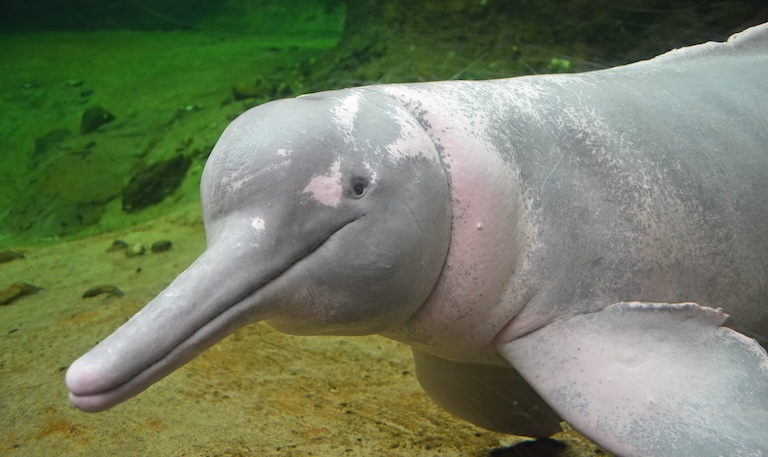
River Dolphin Fact-File Summary
Scientific Classification
| Kingdom: | Animalia |
| Phylum: | Chordata |
| Class: | Mammalia |
| Order: | Artiodactyla |
| Family: | Four families |
| Genus: | Four genera |
| Species Name: | Six species |
Fact Sources & References
- (2024), “5 amazing facts about the Amazon Pink River Dolphin”, Aqua Expeditions .
- , “Protecting river dolphins worldwide”, River Dolphins.org.