
Rhea Profile
In ancient Greek mythology, Gaia, the Earth Goddess, birthed a Titan daughter, sired by her own son and husband, Uranus. The daughter would give birth to Zeus, and then also have babies with him while he was a snake, and Zeus would copulate with his sister Hera too… but they’re gods, so that’s all fine.
What remains a mystery is why this daughter was chosen as the name for an adorable running bird from South America. Rheas may be promiscuous, but they’re not even a bit incestuous, and none has ever sired an air to Mount Olympus.
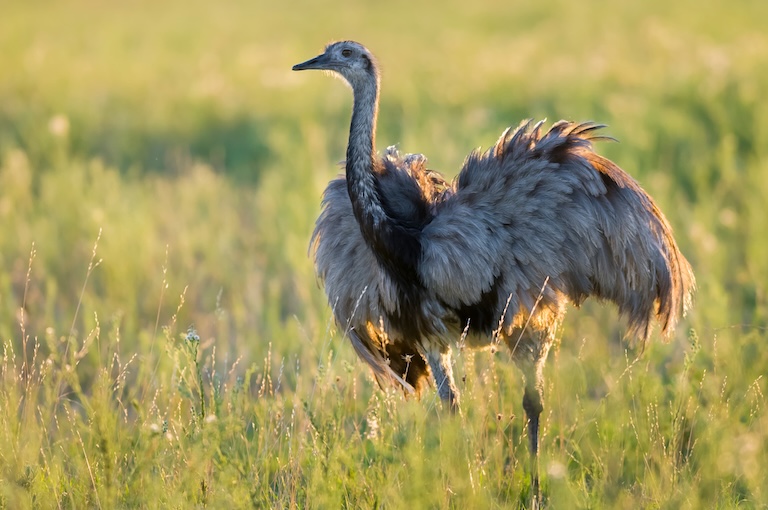
Rhea Facts Overview
| Habitat: | Grasslands, savanna, steppe, wetlands |
| Location: | South and Central America |
| Lifespan: | Around 12 years |
| Size: | Up to 170 cm (67 in) at the head |
| Weight: | Up to 40 kg |
| Colour: | Grey-brown feathers |
| Diet: | Generalist herbivore, some insects |
| Predators: | Caimans, snakes, cougars, jaguars, |
| Top Speed: | 60 kmph (37 mph) |
| No. of Species: | 2 |
| Conservation Status: | Least concern and Near Threatened (Lesser and greater rheas, respectively) |
There are two remaining species of rhea, both in the same genus. The genus Pterocnemia was once used for the lesser rhea, but this has since been dissolved, and the two species are now part of the same Rhea genus.
Rheas then make up a large species and a smaller species, both are nimble, speedy, and gentle animals, who are well equipped to evade predators in the South American plains and wetlands.
Interesting Rhea Facts
1. Ratities
The word ratite sounds like it would refer to a tribe of pirates in a Brian Jacques book, but far from it! These are the largest birds in the world, and though they’re not a taxonomic rank, they are related ecologically, in that they have all evolved to ditch flying in favour of running and being very big. Well, most of them.
Ratities include the ostriches and emus, but also the kiwis, who, despite their size, have been the largest ratite in New Zealand after our species killed all 11 species of enormous moa. But as if to prove a point, the kiwis have turned out to be quite unrelated to the moas and have a closer link to the African species.
Rheas are South America’s entry, and the fourth largest bird in the world after the 2 ostrich and emu, to which they are also somewhat distantly related.
Flighted birds have a ridge on their breast plate, which looks and functions similarly to the keel on the skull of a very powerful biting animal. Both of these ridges function as attachment surfaces for powerful muscles. In biters, it’s called a sagittal crest; in flyers, it’s called a keel. Rattites have neither, and there’s a whole debate around whether this is because they all evolved from a similar ancestor or whether they independently evolved to be very similar.
The latter hypothesis is true to an extent, at least – ratites appear to have evolved flightlessness at least three separate times, and once they do, they almost all seem to get long legs and long necks instead.
As a 40-million-year-old lineage, Rheas are thought to be quite a primitive branch of ratite, with only the ostrich being more basal. Incidentally, kiwis are more closely related to the one-tonne elephant birds! 1
2. They’re not as dangerous as ostriches
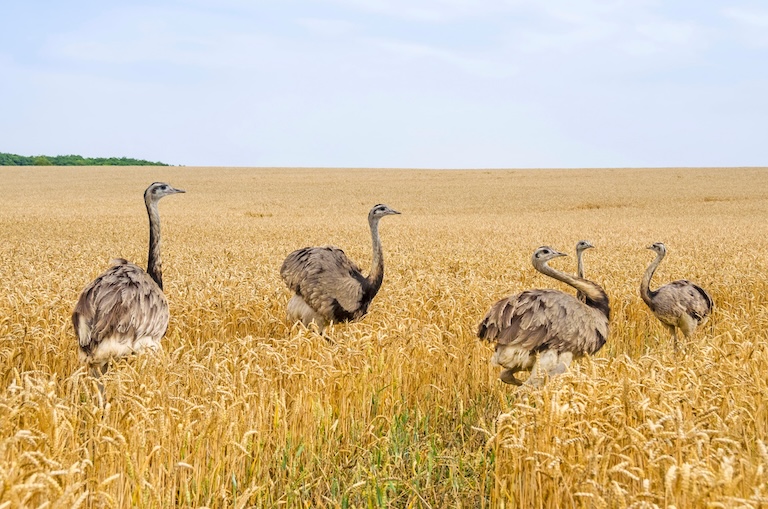
Despite being large birds and being one step removed from the ostrich, rheas are significantly smaller than their African counterparts. The largest is no taller than a person, and substantially lighter, topping out at around 40 kg.
When tamed, they are curious animals, and can be intimidating as such, but with a flat beak designed for pecking at grass, there’s little their faces can do to harm you, even if the pecks might pinch a bit.
A kick from a bird this size could probably do substantially more damage, but rheas don’t appear to have figured out that they can, so it’s not a threat either. Ostriches, on the other hand, are perfectly capable of killing a person when cornered.
In the wild, of course, both birds are shy and run away from people, so almost none of this applies.
And in the wild, not only would you not be able to keep up with a rhea, you’d likely never get anywhere near it.
3. They run
Rheas are some of the fastest animals on two legs, and really are up there with some of the fastest animals on the planet. The fastest bipedal animal on record is the ostrich, which has been known to hit 70 km/h in bursts and can sustain 50 km/h or so for long distances.
Rheas are only marginally slower, at around 60 km/h in bursts, though they are not equipped to sustain runs for very long and tire quickly. This is a product of their environment – they have evolved to escape ambush predators like jaguars, so they only need to be fast briefly.
The lesser rhea is the fastest, with the greater rhea topping out at around 50 km/h. 2
4. They swim
It’s honestly hard to find an animal from South America that doesn’t swim; even the cats do it. So, the smaller species, Darwin’s rhea, doesn’t buck the trend here.
Rheas can cross swamps with their long legs, but where the water is too deep to wade, they simply swim, and they’re good at it. They can cross rivers and lakes this way, and do so to find better feeding or mating grounds, or get to a place with fewer threats.
5. They have good senses
Rheas are pretty sharp animals, as is standard for a prey species, and their hearing and eyesight are both finely attuned.
This makes them jumpy, shy and elusive – all things you need to be if you’re on the menu. They’re even crafty, and will double-back on their escape routes and then hide off to the side to lead predators the wrong way!
Despite being the largest bird in the Americas, they are surprisingly good at being inconspicuous, and are agile enough to turn sharply and throw their hunters off the trail.
6. Males look after the nest
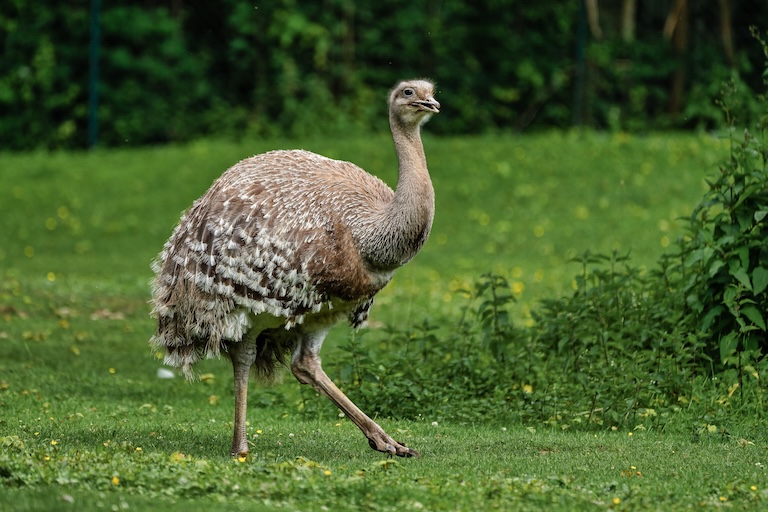
Rheas are pretty social animals, often occupying groups of up to 50 individuals. Most of these will be females or offspring, guarded by a minority of males.
Males can be very defensive, especially in captivity, but they are predominantly gentle herbivores and just want to be left alone.
Males will compete for mating arenas, giving displays similar to those of the ostriches, including calls and dances and lots of wing flapping.
Fights are short and usually undamaging.
Rheas will mate with anyone who’s down and has no intention of making things exclusive. After all is said and done, the females lay the eggs, but it’s the males who do the parenting while the female goes off to find another sperm donor.
Incubation can last 40 days, and this is when the male is most aggressive. After they hatch, he is extremely protective of his offspring. He will provide intensive parenting for 6 months, but they can stick around for up to 3 years in his vicinity before dispersing. 3
7. They’re hunted
The largest threats to both species are human hunting pressure and habitat destruction. Both are considered in decline, but the greater rheas more urgently so, and this species is listed as Near Threatened on the IUCN Red List. 4
As grazers, they are in direct competition with farmers, which usually doesn’t bode well for the wildlife half of the equation.
Fortunately, grassland conservation is rising in popularity in South America, so it’s likely not too late to catch this decline early and maintain a healthy, viable population. 5
Rhea Fact-File Summary
Scientific Classification
| Kingdom: | Animalia |
| Phylum: | Chordata |
| Class: | Aves |
| Order: | Rheiformes |
| Family: | Rheidae |
| Genus: | Rhea |
| Species Name: | pennata and americana |
Fact Sources & References
- Danielle Cholewiak (2003), “Rheidae”, Animal Diversity Web.
- Danielle Cholewiak (2003), “Rheidae ”, Animal Diversity Web.
- (2025), “Greater rhea”, Smithsonian’s National Zoo & Conservation Biology Institute.
- (2022), “Lesser Rhea”, IUCN.
- (2022), “Greater Rhea”, IUCN.